

 English
 中文简体
中文简体






What is the new beach umbrella standard?
Posted by Admin
Content
The New Beach Umbrella Safety Standard: ASTM F3681
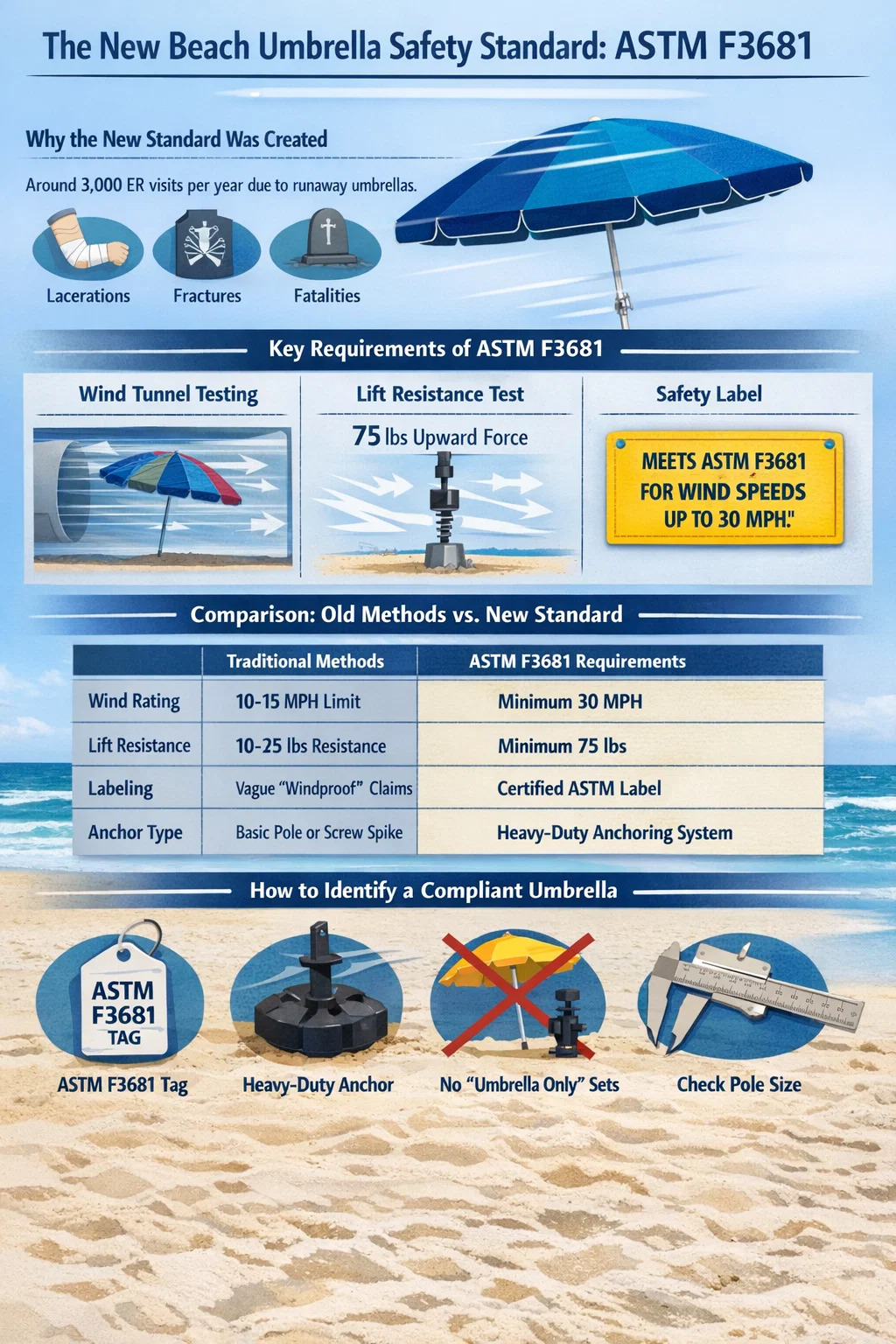
The new beach umbrella standard is ASTM F3681-24 (updated to F3681-25), which establishes the first official performance requirements for wind resistance and anchoring safety. Under this new guideline, a standard beach umbrella with a 7.5-foot diameter must be able to withstand wind speeds of up to 30 miles per hour (MPH) without becoming airborne. Additionally, the anchoring system must provide at least 75 pounds of resistance against upward lift forces to ensure it stays firmly planted in the sand.
Why the New Standard Was Created
For decades, the design of the beach umbrella was left largely unregulated, leading to thousands of injuries every year. Data from the Consumer Product Safety Commission (CPSC) indicated that approximately 3,000 people are treated in emergency rooms annually due to injuries caused by runaway umbrellas. These incidents often involve the umbrella becoming a dangerous projectile in sudden gusts, leading to lacerations, fractures, and even fatalities. The ASTM F3681 standard was developed to force a shift in the industry toward scientifically tested anchoring mechanisms.
Critical Requirements of the ASTM F3681 Standard
The standard is not just a suggestion but a specific set of engineering benchmarks that manufacturers must meet to label their products as "compliant." These benchmarks ensure that the beach umbrella and its accompanying anchor act as a single, secure system.
Mechanical Pull Testing
To pass the mechanical pull test, the anchor device must be installed in the sand according to the manufacturer's instructions. A machine then applies an upward force. For the umbrella to be considered safe for common 7.5-foot models, it must resist at least 75 lbs of force before dislodging.
Wind Tunnel Endurance
The beach umbrella system must remain stable in a wind tunnel for a set duration at a constant speed of 30 MPH. This ensures that the ribs, fabric, and locking mechanisms do not fail under the stress of high-velocity seaside winds.
Mandatory Safety Labeling
Compliant products are now required to feature a specific label. Consumers should look for text stating: “MEETS ASTM F3681 FOR WIND SPEEDS UP TO 30 MPH.” This label must also specify the maximum canopy size that the anchor can safely support.
Comparison: Old Methods vs. New Standard Requirements
Before the introduction of ASTM F3681, many beachgoers relied on "stick and twist" methods that offered very little actual safety. The following table compares traditional setups with the requirements of the new beach umbrella standard.
| Feature | Traditional Methods | New ASTM Standard |
|---|---|---|
| Wind Rating | Typically failed at 10-15 MPH | Minimum 30 MPH |
| Lift Resistance | Estimated 10-25 lbs | Minimum 75 lbs |
| Labeling | Vague "Windproof" claims | Certified ASTM Compliance Label |
| Anchor Type | Pointed pole or basic screw | Tested/Integrated heavy-duty systems |
How to Identify a Compliant Beach Umbrella in 2026
With the 2026 beach season approaching, many retailers are still clearing out old, non-compliant inventory. To stay safe, follow these practical steps when shopping for a beach umbrella:
- Check for the ASTM F3681 Tag: This is the most direct way to verify compliance. Look for it on the carry bag, the anchor device, or the pole itself.
- Evaluate the Anchor Design: Compliant systems often use heavy-duty sand screws or sandbag-weighted bases (like the beachBUB system) that are physically capable of holding the required weight.
- Avoid "Umbrella-Only" Sets: Most umbrellas sold without an anchor do not meet the standard. The standard explicitly states that the umbrella must be used with a compliant anchor to achieve the safety rating.
- Verify Pole Diameter: Many new compliant anchors are designed for 1.1" to 1.5" poles. Ensure your beach umbrella pole matches the anchor's specifications.
Commercial vs. Consumer Compliance
The new beach umbrella standard also has significant implications for hotels, resorts, and beach rental companies. Municipalities are increasingly requiring that all commercial shade structures provided to the public meet ASTM F3681-24 benchmarks to reduce liability. While the standard is technically voluntary for manufacturers, it is quickly becoming a mandatory requirement for insurance providers and beach management agencies across the United States.
Recommended products
Contact Us Now
Copyright 2024 @ Shaoxing Jinqiao Umbrella Co., Ltd. All Rights Reserved. OEM/ODM umbrellas manufacturers Custom Umbrellas Factory
