

 English
 中文简体
中文简体






2-Fold vs 3-Fold Umbrellas: Which One Should You Choose?
Posted by Admin
Content
- 1 The Short Answer: It Depends on How You Use It
- 2 What "2-Fold" and "3-Fold" Actually Mean
- 3 Portability: Where 3-Fold Wins Clearly
- 4 Coverage and Sun Protection: Where 2-Fold Has the Edge
- 5 Durability and Wind Resistance: The Structural Argument
- 6 Beach Umbrella Considerations: A Different Category Entirely
- 7 Opening and Closing Mechanisms: Convenience in Daily Use
- 8 Price, Value, and What You Actually Get for Your Money
- 9 Real-World Scenarios: Matching Fold Type to Lifestyle
- 10 Common Mistakes People Make When Buying Either Type
- 11 Final Verdict: Which Should You Buy?
The Short Answer: It Depends on How You Use It
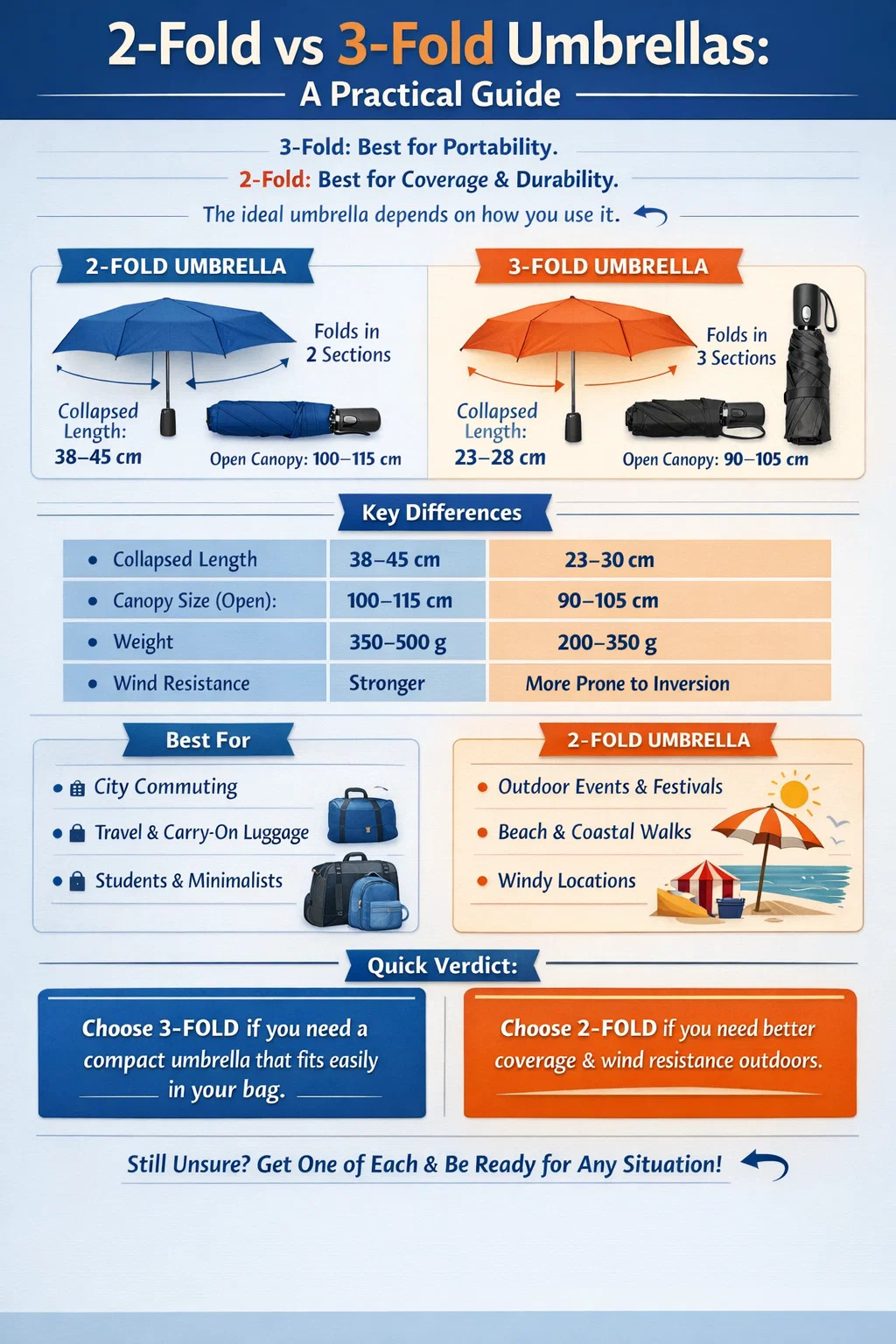
If you need an umbrella for daily commuting, office use, or travel where bag space is tight, a 3-fold umbrella is almost always the better pick. It collapses to roughly 23–28 cm, fits in a jacket pocket or small handbag, and is light enough to carry without noticing. If, on the other hand, you spend a lot of time outdoors — whether you're heading to a beach, a stadium, or a country fair — a 2-fold umbrella gives you a noticeably larger canopy, a sturdier frame, and better wind resistance, at the cost of being bulkier to carry.
That trade-off — portability versus coverage and durability — sits at the heart of this comparison. Everything else flows from it. Let's walk through every angle so you can make the call that actually fits your lifestyle.
What "2-Fold" and "3-Fold" Actually Mean
The number refers to how many sections the shaft collapses into when you close the umbrella. A 2-fold umbrella folds in two sections; a 3-fold folds in three. More folds mean a shorter packed length but also more mechanical joints — and more joints can mean more potential failure points over time.
Typical Dimensions at a Glance
| Feature | 2-Fold Umbrella | 3-Fold Umbrella |
|---|---|---|
| Collapsed Length | 38–45 cm | 23–30 cm |
| Canopy Diameter (open) | 100–115 cm | 90–105 cm |
| Typical Weight | 350–500 g | 200–350 g |
| Number of Shaft Joints | 1 | 2 |
| Typical Rib Count | 8–10 | 6–8 |
| Price Range (mid-market) | $20–$50 | $15–$45 |
As you can see, the differences are real but not dramatic. A few centimetres in collapsed length and 100–150 grams in weight might sound trivial, but when you're cramming things into a shoulder bag or travelling carry-on only, those centimetres matter every single day.
Portability: Where 3-Fold Wins Clearly
The whole reason 3-fold umbrellas exist is portability. At 23–28 cm collapsed, the smallest models slip into the side pocket of a backpack, a clutch bag, or even a deep jacket pocket. That means you're far more likely to actually have the umbrella with you when the sky turns grey — which is, ultimately, the only thing that matters.
A 2-fold umbrella at 40+ cm collapsed will need a dedicated bag slot or a tote. It's not that it's unportable — plenty of people carry them daily — but the sheer size means you're far more likely to leave it at home on a morning when you're already running late. That's the hidden cost of the 2-fold's extra coverage: you sometimes don't have it when you need it.
Who Should Prioritise Portability
- City commuters who walk between public transport stops and the office
- Travellers packing into carry-on luggage only
- Students who carry a full backpack and don't want extra bulk
- Anyone who regularly forgets umbrellas and wants something small enough to live in their bag permanently
For these users, the 3-fold is the pragmatic choice, full stop.
Coverage and Sun Protection: Where 2-Fold Has the Edge
When you open a quality 2-fold umbrella, you typically get a canopy of 105–115 cm in diameter. That's enough to comfortably shelter two adults walking side by side, or one adult with a pushchair. The larger canopy area also means more shade — useful not just in rain but also for sun protection, which is increasingly why people carry umbrellas year-round.
This is especially relevant when you think about outdoor use at the beach or in open spaces. A beach umbrella or sun parasol is essentially a large 2-fold-style concept scaled up: maximum shade area, planted in the sand, no portability needed. The 2-fold compact umbrella sits closer to that philosophy — it prioritises coverage when open over how small it gets when closed.
UPF Ratings and Sun Protection
Both 2-fold and 3-fold umbrellas can carry UPF (Ultraviolet Protection Factor) ratings, but the larger canopy of a 2-fold provides coverage over a bigger surface area. A UPF 50+ canopy blocks more than 98% of UV radiation regardless of size, but the extra 10–15 cm of diameter on a 2-fold means your arms, shoulders, and the top of your head stay better protected when the sun is at an angle. If sun protection is a priority — say, you're managing skin conditions or have had skin cancer — the 2-fold's canopy advantage is real and meaningful.
Durability and Wind Resistance: The Structural Argument
This is where the 2-fold umbrella makes its strongest case. Fewer folds mean fewer mechanical joints, and fewer joints mean fewer things that can go wrong. Every fold point on an umbrella shaft is a stress point. In a heavy gust, the force travels up the shaft and hits those joints first. A 2-fold shaft, with only one fold point, distributes that stress differently than a 3-fold shaft with two.
Wind tunnel tests published by consumer product labs consistently show that, at equivalent price points, 2-fold umbrellas with fibreglass-reinforced ribs outperform 3-fold models when exposed to winds above 50 km/h. At that wind speed, cheaper 3-fold models often invert at the second joint before the canopy itself fails. If you live somewhere with frequent gusty conditions — coastal areas, open hillside towns, or anywhere that sees regular 40–60 km/h winds — a well-built 2-fold is likely to last you noticeably longer.
What to Look for in Rib Construction
- Fibreglass ribs: Flexible enough to bend without snapping; found in mid-to-high range models of both types
- Steel ribs: Heavier but very strong; common in budget 2-fold models
- Aluminium shaft: Lightweight but less rigid under lateral force than steel
- Rib count: 8 ribs outperform 6 in wind resistance at any fold count
The key takeaway: rib material and count matter as much as fold count when judging durability. A high-end 3-fold with 8 fibreglass ribs will outlast a budget 2-fold with 6 steel ribs in a storm.
Beach Umbrella Considerations: A Different Category Entirely
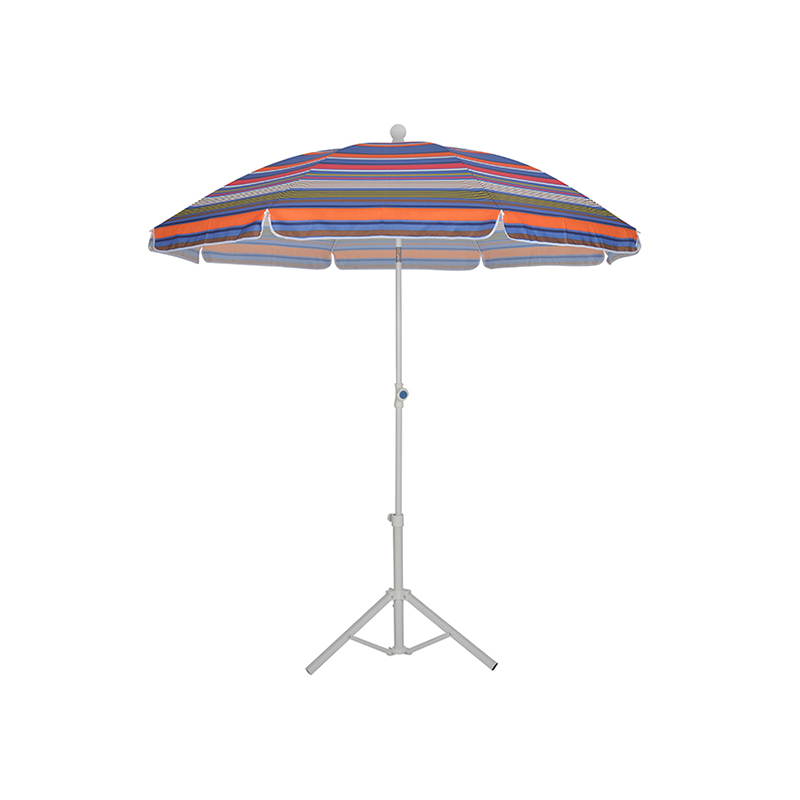
When people search for beach umbrella options and land on this comparison, it's worth being direct: neither a 2-fold nor a 3-fold compact umbrella is a substitute for a purpose-built beach umbrella. A proper beach umbrella — the kind you anchor into the sand with a screw-tip or sand anchor — typically measures 180–240 cm in diameter and is engineered to withstand coastal wind conditions while protecting multiple people.
That said, if you're asking which compact fold umbrella is better suited to beach day use — perhaps you're walking to the beach, need shade while waiting for your spot, or want sun protection while sitting outside a beachside café — the 2-fold is a more practical choice. Its larger canopy provides more meaningful shade when the sun is high, and its sturdier frame copes better with the gusts typical of open coastal locations.
Choosing a Proper Beach Umbrella vs a Compact Umbrella for Beach Use
| Use Case | Best Option | Why |
|---|---|---|
| Full day on the sand with family | Dedicated beach umbrella (180–240 cm) | Ground-anchored, large coverage, freestanding |
| Walking to/from the beach with sun protection | 2-fold compact umbrella with UPF 50+ | Larger canopy, good wind resistance, portable |
| Quick beach visit, light packing required | 3-fold compact umbrella with UPF rating | Fits in any bag, good enough for short stints |
| Beachside café or market stall shade | 2-fold compact umbrella | Better shade coverage while seated |
A quality beach umbrella designed for sand use is a separate product category with very different engineering priorities. If your primary need is beach shade, invest in the right tool rather than stretching a compact umbrella beyond what it was built for.
Opening and Closing Mechanisms: Convenience in Daily Use
Both 2-fold and 3-fold umbrellas come in manual and automatic variants. Auto-open (and increasingly auto-open/auto-close) mechanisms are now widely available across both categories. However, because 3-fold shafts are more mechanically complex, the auto-close mechanism on a 3-fold involves more moving parts and, statistically, has a slightly higher failure rate over the product's lifetime.
Manual 2-fold umbrellas are often preferred by people who want the most mechanically simple and longest-lasting product. You trade a small convenience for meaningfully better long-term reliability.
Auto vs Manual: A Quick Comparison
- Auto-open only: Convenient for opening one-handed in the rain; closing still requires manual effort; available on both fold types
- Auto-open/auto-close: Maximum convenience; more complex mechanism; more common and generally more reliable on 2-fold than 3-fold due to simpler shaft
- Fully manual: Simplest mechanism; most durable over time; works fine in practice for most users
Price, Value, and What You Actually Get for Your Money
Both fold types are available across a wide price spectrum — from under $10 supermarket impulse buys to $80+ designer or premium brand options. The fold type itself doesn't dictate where in that range you land. What matters more is the quality of materials: fibreglass vs steel ribs, Pongee vs coated polyester fabric, aluminium vs carbon shaft.
At the $25–$45 mid-market sweet spot, you can get a genuinely good umbrella in either format. Spending under $15 on either type is a false economy — the joint mechanisms on budget models typically fail within 6–12 months of regular use, whether that's a 2-fold or a 3-fold. The fold design doesn't protect a badly-made umbrella from early failure.
What a Good Mid-Range Umbrella of Either Type Should Include
- Fibreglass or mixed fibreglass-steel ribs (at least 8 ribs)
- Pongee or coated polyester fabric with a water-repellent finish (DWR coating)
- A solid locking mechanism at each fold joint that doesn't rattle when open
- A comfortable, non-slip handle — rubber, wood, or textured plastic
- A carry sleeve or pouch that actually fits the umbrella without a wrestling match
Real-World Scenarios: Matching Fold Type to Lifestyle
Rather than abstract comparisons, here's how to think about this in concrete, everyday terms:
Scenario 1: Daily City Commuter
You commute by tube or tram, carry a medium-sized shoulder bag, and mainly need cover for the 5–10 minute walk between stops and your office. You're sheltered most of the time. Best choice: 3-fold. It lives in your bag permanently, you barely notice it's there, and it's there when you need it.
Scenario 2: Outdoor Festival or Market Goer
You spend 4–6 hours outdoors at weekend events, markets, or outdoor concerts. You carry a large tote or rucksack. You need proper rain coverage and want something that won't collapse in a gust. Best choice: 2-fold with 8+ fibreglass ribs. Better coverage, sturdier in wind, and the extra size in your bag isn't a real problem when you're already carrying plenty.
Scenario 3: Coastal Resident with Occasional Beach Days
You live near the coast, deal with strong sea breezes regularly, and want an umbrella you can also use as a sun parasol when walking to a beach or promenade. Best choice: 2-fold with UPF 50+ canopy. Handles the wind better, covers more of you, and the UPF fabric gives meaningful sun protection. For full beach shade, supplement with a dedicated beach umbrella or pop-up shelter.
Scenario 4: Frequent Traveller
You travel several times a month, pack carry-on only, and need an umbrella that works in a range of climates. Best choice: 3-fold. Compact enough to never cause a packing problem, good enough coverage for the urban environments most business travel involves. Look for a 3-fold with 8 ribs and a windproof canopy design.
Scenario 5: Parent With Young Children
You're often out with a pushchair or holding a child's hand. You need an umbrella large enough to cover you and lean over a pushchair canopy. You're likely carrying a changing bag that already has space. Best choice: 2-fold with a large canopy. The extra coverage is genuinely useful here. Some parents opt for a dedicated 2-fold "walking umbrella" (non-folding, straight shaft) for maximum canopy size, but that's a different category again.
Common Mistakes People Make When Buying Either Type
- Buying cheap and blaming the fold type: A $9 3-fold will fall apart. That's not the 3-fold design failing — that's cheap manufacturing failing. Don't draw conclusions about fold type from budget product failures.
- Ignoring rib count: A 3-fold with 8 ribs will outperform a 2-fold with 6 in most wind conditions. Rib count matters as much as fold number.
- Using a compact umbrella as a beach umbrella: Neither fold type is anchored to the ground. On a beach with a 30 km/h sea breeze, an unanchored compact umbrella becomes a projectile. Use a proper sand-anchored beach umbrella for beach days.
- Overlooking fabric quality: A canopy that soaks through in heavy rain is useless regardless of fold type. Check that the DWR (durable water repellent) coating is either factory-applied or the fabric is Pongee-based.
- Forcing a closed umbrella into too-small a sleeve: This stresses the fold joints and degrades them over time. Make sure the carry sleeve actually fits the umbrella comfortably before buying.
Final Verdict: Which Should You Buy?
The choice between a 2-fold and a 3-fold umbrella is genuinely a lifestyle fit question, not a quality question. Neither is objectively superior across all situations. Here's the clearest summary possible:
- Choose a 3-fold if portability is your top priority, you commute or travel frequently, and you need something that always fits in your bag without any fuss.
- Choose a 2-fold if coverage, durability, and wind resistance matter more to you, you live somewhere with strong or unpredictable winds, or you spend extended time outdoors — including beach walks, markets, or outdoor events.
If you genuinely can't decide, buy one of each at the $25–$40 price point — keep the 3-fold in your everyday bag and the 2-fold by the door for days when you know the weather is going to be rough. The combined spend is still less than a single premium umbrella, and you've covered every real-world scenario.
And if your main concern is beach shade, step past the compact umbrella category entirely and invest in a proper anchored beach umbrella rated for coastal wind conditions. That's a different product doing a different job — and it does it far better than any 2-fold or 3-fold ever will.
Recommended products
Contact Us Now
Copyright 2024 @ Shaoxing Jinqiao Umbrella Co., Ltd. All Rights Reserved. OEM/ODM umbrellas manufacturers Custom Umbrellas Factory
