

 English
 中文简体
中文简体






What Size Beach Umbrella Is Best? A Complete Guide
Posted by Admin
Content
- 1 The Short Answer: What Size Beach Umbrella Do You Actually Need?
- 2 How Canopy Size Translates to Real Shade — It's Not Just the Diameter
- 3 Choosing the Right Beach Umbrella Size Based on Group Size
- 4 Wind Resistance and Stability — Why Size Affects Safety Too
- 5 Portability vs. Coverage: Finding the Balance That Works for You
- 6 Beach Umbrella Pole Diameter and Material — What Supports a Larger Canopy
- 7 Beach Umbrella vs. Beach Tent — When Size Isn't Enough
- 8 Features That Make Any Size Beach Umbrella Perform Better
- 9 Common Mistakes When Choosing a Beach Umbrella Size
- 10 Recommended Beach Umbrella Sizes by Use Case — Final Summary
The Short Answer: What Size Beach Umbrella Do You Actually Need?
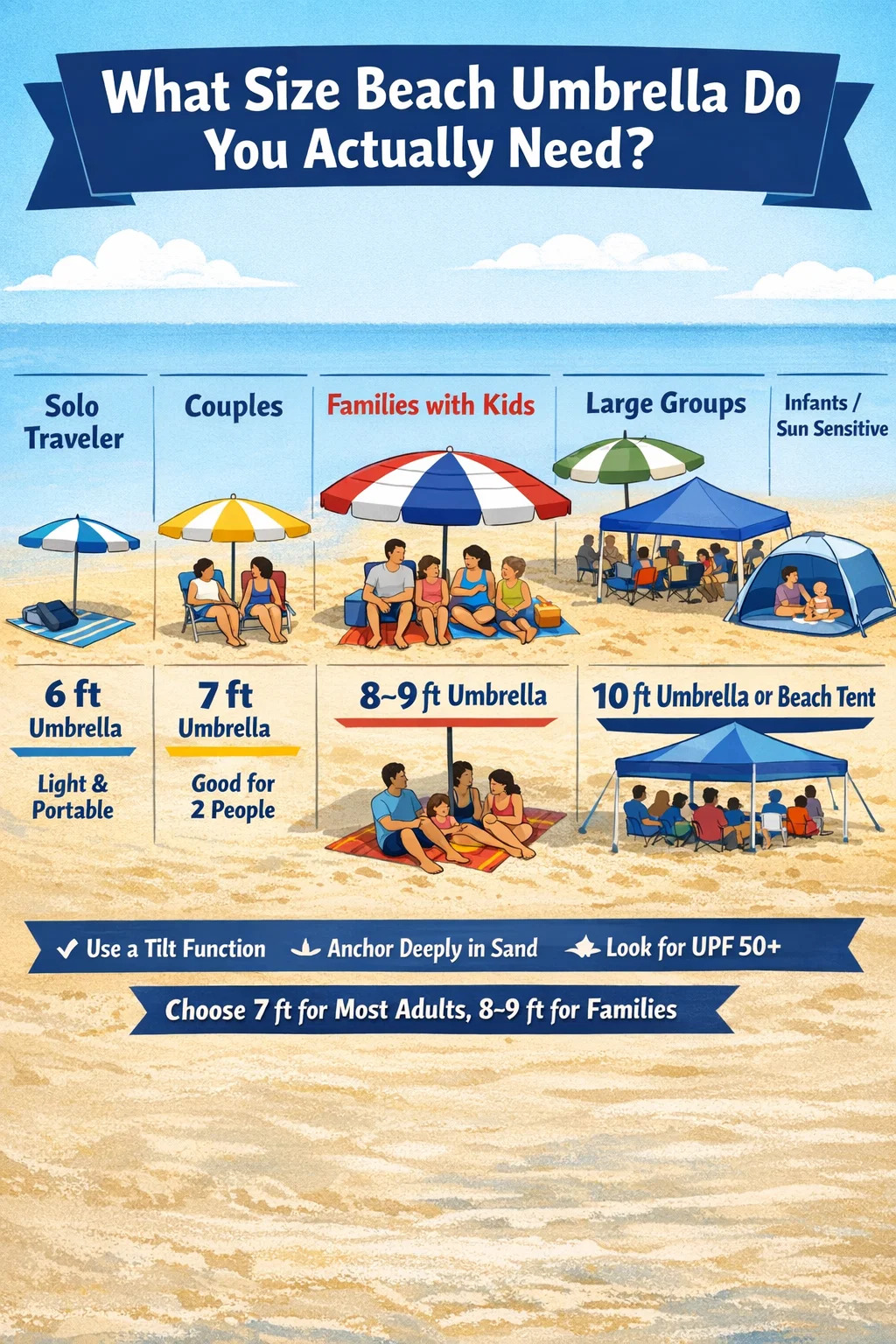
For most solo beachgoers or couples, a 7-foot beach umbrella is the sweet spot — it provides enough shade for one to two people lying on towels without being awkward to carry or set up. For families of three or more, stepping up to a 8- to 9-foot umbrella is worth every inch. If you're heading out solo and traveling light, a 6-foot model works fine but leaves little room for error when the sun shifts.
The diameter of a beach umbrella refers to the canopy width when fully open. That number sounds straightforward, but the actual usable shade it casts depends on the sun angle, the umbrella's tilt range, and how close to the ground it sits. A 7-foot canopy casts roughly 28 to 35 square feet of shade at midday — enough for two beach chairs and a cooler. A 9-foot canopy can cover closer to 50 to 60 square feet, which comfortably fits a family of four with gear.
Before getting into the specifics, here's a quick reference to anchor the rest of this guide:
| Umbrella Size | Best For | Approx. Shade Coverage | Typical Weight |
|---|---|---|---|
| 6 ft | Solo travelers, kids | ~20–24 sq ft | 2–3.5 lbs |
| 7 ft | Solo or couples | ~28–35 sq ft | 3–5 lbs |
| 8 ft | Small families, 3–4 people | ~38–45 sq ft | 4–6.5 lbs |
| 9 ft | Families, groups of 4–6 | ~50–60 sq ft | 5–8 lbs |
| 10 ft+ | Large groups, commercial use | 65 sq ft+ | 7–12 lbs |
How Canopy Size Translates to Real Shade — It's Not Just the Diameter
A lot of people assume the listed diameter equals the shaded area they'll get. It doesn't work that way. The shade cast by a beach umbrella is shaped like an oval or ellipse because of the sun angle — especially in the morning and late afternoon when the sun is lower on the horizon. At those times, the shade stretches out long in one direction and narrow in the other. At high noon, the shade is more circular and closer in diameter to the actual canopy.
The pole height also plays a role. Most beach umbrellas stand between 5 and 6.5 feet tall when anchored in sand. A taller pole raises the canopy higher off the ground, which allows more people to sit under it comfortably but also reduces how deep the shade reaches at the edges. Some large beach umbrella models offer adjustable pole heights specifically for this reason.
Tilt functionality is another key factor. Many quality beach umbrellas include a tilt mechanism — usually a push-button or pin-lock system — that lets you angle the canopy toward the sun. A 30- to 45-degree tilt can effectively add 20 to 30 percent more usable shade compared to a straight vertical position. If you're comparing two umbrellas that are similar in size, the one with a better tilt range will almost always outperform in real-world use.
Canopy shape also matters. Round canopies are the most common and provide even shade in all directions. Square or rectangular canopies, sometimes called beach canopy tents or cabana-style umbrellas, can cover more linear space — useful if you're setting up chairs in a row. Some rectangular beach shade options measure 6 by 8 feet or 7 by 9 feet, giving an elongated footprint that works better for multiple loungers laid side by side.
Choosing the Right Beach Umbrella Size Based on Group Size
Solo Beachgoers
If you're going to the beach alone, a 6- to 6.5-foot beach umbrella is perfectly adequate. These models are lightweight — often under 3 pounds — and compact enough to fit inside a beach bag or backpack. The shade coverage is enough for one person on a towel or in a low beach chair. You won't have a ton of overflow shade, but for a solo setup with a book and a drink, it does the job without the hassle of hauling something larger.
Popular compact beach umbrellas in this range include models from Sport-Brella and AmazonBasics that weigh around 2.8 to 3.2 pounds and fold down to roughly 28 to 32 inches — easy to carry in one hand alongside a bag.
Couples
Two people lying on towels or sitting in beach chairs need more coverage than a 6-foot umbrella comfortably provides, especially if there's gear involved. A 7-foot umbrella works well here, giving each person room to shift around as the sun moves without fighting over a sliver of shade. Look for models with a reliable tilt mechanism so you can maximize coverage throughout the day without repositioning the entire pole.
If both of you are tall or you tend to sprawl out, consider an 8-foot model. The weight difference is usually only 1 to 2 pounds, and the extra foot of canopy diameter adds noticeably more shade area without being cumbersome to set up.
Families with Kids
This is where an 8- to 9-foot beach umbrella earns its place. With kids, there's always more gear — sand toys, snacks, an extra towel, maybe a small cooler. A larger canopy ensures the adults aren't sacrificing their own shade to cover equipment. A 9-foot umbrella can comfortably shade two adults in chairs plus two young children on a blanket in front of them, with room for a small cooler on the side.
For families who frequently go to the beach, investing in a quality large beach umbrella with a vented canopy — which reduces wind resistance and helps prevent the umbrella from becoming a sail — is a smart move. Brands like Tommy Bahama, Blissun, and GreenBay offer 8- to 9-foot vented models in the $40 to $80 range that hold up well to repeated use.
Large Groups
For groups of five or more, a single umbrella isn't really practical regardless of size. A better approach is to use two 7- to 8-foot umbrellas spaced close together, or to switch to a beach tent or canopy shelter. That said, 10-foot beach umbrellas do exist and are popular for commercial beach rentals. They provide a large central shade area but typically require more serious anchoring and become difficult to manage in moderate wind.
Wind Resistance and Stability — Why Size Affects Safety Too
Beach umbrella safety is a real concern that often gets overlooked in size discussions. Every year, beach umbrellas become airborne and injure bystanders. In 2016, a beach umbrella in Virginia Beach injured multiple people when it became a projectile in moderate wind. The larger the canopy, the more wind load it bears — and the more deeply it needs to be anchored.
A general rule of thumb: the pole should be inserted into the sand at least 12 to 18 inches deep, and ideally at a slight angle (about 30 degrees) pointing into the wind. For large beach umbrellas (8 feet and above), using a sand anchor — a screw-style base that's twisted into the sand — dramatically improves stability. These sand anchors are inexpensive ($10 to $25) and are worth adding to any beach kit if you're using a larger canopy.
Some beach umbrellas include a built-in wind vent at the top of the canopy. This vent allows wind to pass through the top, reducing the upward lift force that sends umbrellas flying. Vented canopies are strongly recommended for any umbrella 7.5 feet or larger, particularly in coastal areas where afternoon gusts are common. The vent typically reduces wind resistance by 15 to 25 percent, which may not sound like much but makes a measurable difference when a 20 mph gust rolls through.
UPF (Ultraviolet Protection Factor) rating is a separate but related consideration. Most quality beach umbrellas offer UPF 50+, which blocks at least 98 percent of UV radiation. Look for this rating on any umbrella you buy — it's not universal, and cheaper models sometimes omit it. The canopy material (typically polyester or nylon) and its weave density determine the UPF rating, not the size. But larger canopies give you more surface area to stay under, which reduces the risk of sun exposure from the sides when the sun is at a low angle.
Portability vs. Coverage: Finding the Balance That Works for You
There's an unavoidable trade-off between how much shade a beach umbrella provides and how easy it is to carry. Here's how it plays out in practice:
- A 6-foot umbrella typically folds down to 27–30 inches and weighs under 3 pounds. It fits in most beach bags and requires no separate carrying case.
- A 7-foot umbrella folds to roughly 30–36 inches and weighs 3–5 pounds. Most come with a carry bag or sleeve and can be easily carried over the shoulder.
- An 8-foot umbrella folds to about 36–42 inches and weighs 4.5–6.5 pounds. It usually requires a dedicated carry bag and starts to feel noticeable on a longer beach walk.
- A 9-foot umbrella may fold to 40–48 inches and weigh 6–9 pounds. It's manageable for most adults but can feel unwieldy if you're also carrying chairs, a cooler, and bags.
If portability is a top priority — for example, you're taking public transit to the beach or hiking across soft sand for a significant distance — don't go larger than you genuinely need. A well-positioned 7-foot umbrella with a good tilt function will serve most couples far better than a 9-foot model that gets left in the car because it's too inconvenient to carry.
On the other hand, if you drive right up to the beach or rent a cart, the portability issue largely disappears. In that case, size up. The extra shade coverage on a hot day is always appreciated, and a larger umbrella makes your beach setup feel more like a home base.
Beach Umbrella Pole Diameter and Material — What Supports a Larger Canopy
The pole is the backbone of any beach umbrella, and its quality becomes more important as canopy size increases. On a 6-foot umbrella, a thin fiberglass or steel pole may be acceptable. On a 9-foot model catching ocean breezes, you want something sturdier.
Common pole materials include:
- Steel: Heavy but strong. Resists bending in wind. Good for larger umbrellas but adds weight. A steel pole on a 9-foot umbrella might weigh 2 to 3 pounds on its own.
- Aluminum: Lighter than steel, corrosion-resistant, and strong enough for most beach conditions. The most popular pole material in mid-range to premium beach umbrellas.
- Fiberglass: Flexible and lightweight. Often used in budget models. Works fine for smaller canopies but can snap under wind stress on larger ones.
- Carbon fiber: Found in high-end models. Extremely lightweight and strong. Adds significant cost but reduces overall umbrella weight noticeably.
Pole diameter is also worth paying attention to. Budget beach umbrellas often use poles around 0.75 to 1 inch in diameter. Quality large beach umbrellas step up to 1.25 to 1.5 inches, which provides meaningfully better resistance to bending and snapping. If a product listing doesn't mention pole diameter, that's usually a sign the manufacturer doesn't consider it a selling point — which itself tells you something.
Beach Umbrella vs. Beach Tent — When Size Isn't Enough
There's a point at which a larger beach umbrella becomes less practical than a beach tent or pop-up canopy. If you need shade for five or more people, or if you're going to a very sunny and exposed beach where side-sun is a real issue, a beach shade shelter may be a better investment than hunting for the biggest umbrella available.
Beach tents and cabana-style shelters typically cover 60 to 100+ square feet and provide shade on three sides instead of just from above. They're heavier and bulkier than umbrellas but offer full shade for larger groups. Models from brands like Pacific Breeze, Neso, and Coleman are popular choices in the $50 to $150 range.
For families with young children or anyone with high sun sensitivity, a beach tent actually provides better UV protection because it blocks low-angle sun that an umbrella cannot. Pediatric dermatologists often recommend beach shade tents for infants and toddlers specifically because overhead-only protection is insufficient when the sun is near the horizon.
That said, beach umbrellas have clear advantages in setup speed, adjustability, and the ability to angle coverage as the sun moves. A beach tent stays fixed in one orientation. For most adults and older kids who can apply sunscreen and position themselves, a properly sized beach umbrella remains the more flexible and practical tool.
Features That Make Any Size Beach Umbrella Perform Better
Once you've narrowed down the right size, these features separate an average beach umbrella from a genuinely useful one:
Tilt Mechanism
A push-button or pin-lock tilt system lets you angle the canopy toward the sun without pulling up the entire pole. This is one of the most practical features on any beach umbrella and should be non-negotiable on any model 7 feet or larger. Some umbrellas tilt only in one direction; the best ones offer multi-directional tilting.
Wind Vent
As mentioned earlier, a vent at the top of the canopy reduces uplift and improves stability. Double-canopy designs — where the vent is created by a second layer of fabric slightly above the main canopy — are more effective than single-layer vents and also look more finished.
Sand Anchor Compatibility
Check whether the pole diameter is compatible with standard screw-style sand anchors. Most sand anchors fit poles between 0.75 and 1.5 inches in diameter, but it's worth confirming before you buy. A sand anchor keeps your umbrella secure in loose sand and is especially important on windy beaches or when using a larger canopy.
UPF Rating
Look for UPF 50+ certification. This tells you the fabric has been tested and blocks at least 98 percent of UV radiation. Some umbrella descriptions say "UV protection" without specifying a rating — that language is vague and should be treated with skepticism.
Carry Bag or Sleeve
A quality carry bag keeps the umbrella compact, protects the canopy from abrasion in transit, and makes it easier to sling over a shoulder. Look for bags with a shoulder strap rather than just a top handle — on a longer walk across the beach, the difference matters.
Canopy Material
Polyester is the most common material and balances cost, weight, and UV resistance well. Olefin and nylon are also used in higher-end umbrellas. Avoid cheap canopies that feel thin or translucent when held up to light — they typically have low UPF ratings and fade quickly after a few seasons of use.
Common Mistakes When Choosing a Beach Umbrella Size
These are the sizing mistakes that come up most often — and they're all easy to avoid once you know what to look for:
- Buying a 6-foot umbrella for two people: It works in calm conditions at midday, but as the sun shifts even slightly, one person loses shade. For couples, the 7-foot size is the minimum worth buying.
- Assuming diameter equals shade coverage: The listed diameter is the canopy width, not the shaded footprint on the ground. Real-world shade coverage depends on sun angle, pole height, and tilt. Plan for the canopy to shade a slightly smaller area than its diameter suggests.
- Ignoring wind conditions: If your usual beach is exposed and windy, going bigger isn't always better. A well-anchored 7-foot vented umbrella will outperform a 9-foot flat-canopy model in wind, every time.
- Prioritizing price over pole quality: On small umbrellas, a flimsy pole is an annoyance. On a large beach umbrella, it's a safety issue. Spend a bit more on a model with an aluminum or steel pole of at least 1.25 inches in diameter.
- Skipping the tilt feature: A beach umbrella without a tilt mechanism requires you to reposition the entire pole every time the sun moves. Over a 4-hour beach session, that gets old fast. Tilt-capable models cost only a little more and are worth every dollar.
Recommended Beach Umbrella Sizes by Use Case — Final Summary
To pull everything together, here's a practical size guide based on common beach scenarios:
| Use Case | Recommended Size | Key Features to Look For |
|---|---|---|
| Solo traveler, light packing | 6–6.5 ft | Lightweight, compact fold, carry bag |
| Couple or two adults | 7 ft | Tilt mechanism, UPF 50+, vented canopy |
| Family of 3–4 | 8–9 ft | Strong pole (1.25"+ aluminum), sand anchor, wind vent |
| Group of 5+ | Two 7–8 ft umbrellas or beach tent | Stability, multiple anchor points |
| Infants or high sun sensitivity | Beach tent/canopy shelter | 3-sided coverage, UPF 50+, easy setup |
| Commercial/rental use | 9–10 ft | Heavy-duty steel pole, sand anchor required |
The right beach umbrella size is the one that actually fits your group, your beach, and your carrying capacity — not the largest one that technically exists. For the vast majority of people, a 7-foot beach umbrella with a tilt mechanism and UPF 50+ canopy is the single best all-around choice. Go up to 8 or 9 feet for families, and down to 6 feet if you're traveling light and going solo. Whatever size you choose, anchor it properly, tilt it toward the sun, and you'll get far more out of it than most people do.
Recommended products
Contact Us Now
Copyright 2024 @ Shaoxing Jinqiao Umbrella Co., Ltd. All Rights Reserved. OEM/ODM umbrellas manufacturers Custom Umbrellas Factory
