

 English
 中文简体
中文简体






Can You Still Get Sun Under a Beach Umbrella? Full Answer
Posted by Admin
Content
- 1 Yes, You Can Still Get Sun Under a Beach Umbrella
- 2 How UV Radiation Actually Reaches You at the Beach
- 3 How Much UV Protection Does a Beach Umbrella Actually Provide
- 4 The Role of Sand and Water in Amplifying UV Under Your Umbrella
- 5 Common Mistakes People Make With Beach Umbrellas
- 6 Can You Tan or Burn Under a Beach Umbrella
- 7 How to Maximize Sun Protection When Using a Beach Umbrella
- 8 Comparing Beach Umbrella Protection to Other Shade Options
- 9 What Color Beach Umbrella Offers the Best Protection
- 10 Skin Types and How They Affect Risk Under a Beach Umbrella
- 11 The Bottom Line on Beach Umbrella Sun Protection
Yes, You Can Still Get Sun Under a Beach Umbrella
If you've ever spent a long afternoon sitting under a beach umbrella and still walked away with a sunburn, you weren't imagining it. A beach umbrella blocks direct sunlight but does not eliminate UV exposure. Studies have confirmed that sitting under a standard beach umbrella still exposes you to a significant amount of ultraviolet radiation — both from the sky and reflected off surrounding surfaces like sand, water, and even nearby towels.
A widely cited clinical study published in JAMA Dermatology found that participants who relied solely on a beach umbrella for sun protection had a higher rate of sunburn than those who used sunscreen alone. Specifically, 78% of umbrella-only participants experienced sunburn, compared to 25% of those using SPF 100 sunscreen. That's a striking result that most beachgoers never consider when they feel safely tucked away in the shade.
The core reason comes down to how UV radiation actually travels. Sunlight doesn't just come straight down from above — it scatters across the entire sky, bounces off reflective surfaces, and reaches you from multiple angles simultaneously. A beach umbrella can only block the cone of direct overhead radiation. Everything else still gets through.
How UV Radiation Actually Reaches You at the Beach
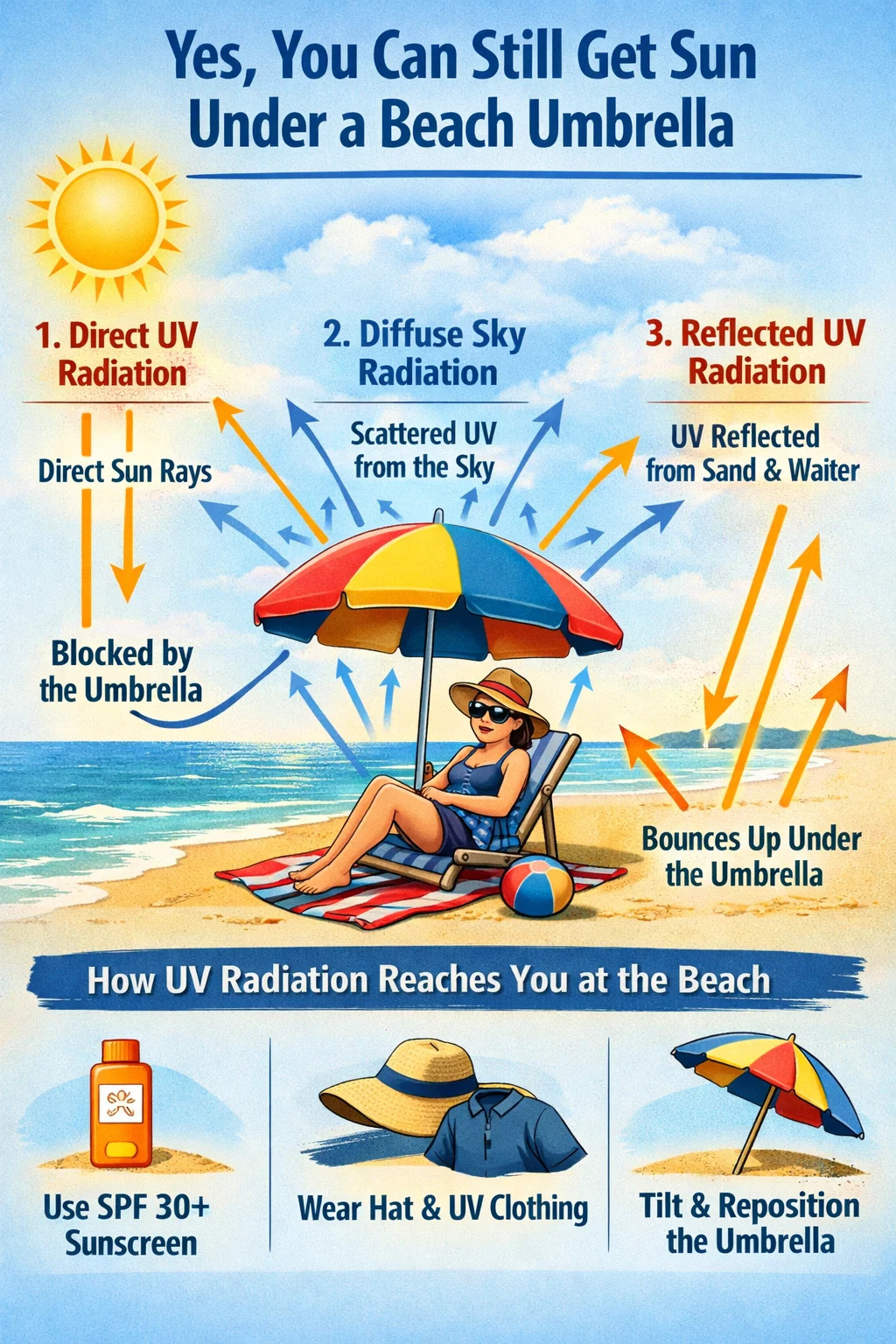
Understanding why you can still get sun under a beach umbrella requires a basic understanding of how UV light behaves outdoors. There are three distinct pathways through which UV reaches your skin at the beach:
Direct UV Radiation
This is the sunlight that travels in a straight line from the sun directly to your skin. A beach umbrella is most effective at blocking this type of exposure, especially when positioned correctly with the canopy tilted toward the sun. However, direct radiation only accounts for a portion of total UV exposure at the beach.
Diffuse Sky Radiation
UV rays scatter as they pass through the atmosphere, meaning UV light arrives from all parts of the sky — not just from the direction of the sun. This scattered radiation, known as diffuse UV, can contribute up to 50% of total UV exposure on a clear day. Because it comes from every direction, a beach umbrella with an open canopy can't block it. You're still receiving this ambient UV from the sides and angles that the umbrella doesn't cover.
Reflected UV Radiation
Surfaces around you act like mirrors for UV light. Dry sand reflects approximately 15–25% of UV radiation, while sea foam and white beach surfaces can reflect even more. Water reflects between 5% and 10% under typical conditions, but that percentage rises sharply when the sun is at a low angle. Snow reflects up to 80%, but even at the beach the combined effect of sand and water creates meaningful secondary UV exposure that bounces directly under your umbrella from below and from the sides.
How Much UV Protection Does a Beach Umbrella Actually Provide
The protection a beach umbrella offers varies considerably depending on the umbrella's material, UPF rating, size, color, and how it's positioned relative to the sun. Not all beach umbrellas are created equal, and treating them as interchangeable is a common mistake.
| Umbrella Type | Typical UPF Rating | UV Blocked (Approx.) | Notes |
|---|---|---|---|
| Standard nylon/polyester umbrella | UPF 15–30 | 70–90% | Commonly sold at discount stores; fades over time |
| UV-coated or treated fabric umbrella | UPF 30–50 | 93–97% | Better protection; check labels before purchasing |
| UPF 50+ rated beach umbrella | UPF 50+ | 98%+ | Blocks nearly all direct UV; still doesn't cover diffuse/reflected rays |
| Cheap cotton or light-colored canvas | UPF 5–15 | 50–70% | Often allows visible UV transmission; avoid for sun protection |
Even with a high-quality UPF 50+ beach umbrella, you're still exposed to diffuse and reflected UV radiation that comes from outside the umbrella's coverage area. Researchers estimate that total UV exposure under a beach umbrella — accounting for scatter and reflection — can still be anywhere from 34% to 84% of full unshaded exposure, depending on conditions.
The Role of Sand and Water in Amplifying UV Under Your Umbrella
The beach environment itself is one of the most UV-intense environments you can spend time in, and much of that has to do with what surrounds you rather than what's overhead. Sand and water work together to dramatically amplify your UV exposure in ways that no umbrella can counteract.
Light-colored, fine-grained beach sand can reflect a substantial portion of incoming UV radiation back upward. When you're lying on the sand under an umbrella, reflected UV is essentially hitting you from below — areas like the underside of your chin, your nose, inner arms, and legs all receive significant reflected exposure. This is why beachgoers often notice they've tanned or burned on their underside even when they felt completely shaded.
Water creates a similar effect. If you're near the shoreline, the rippling water surface acts as thousands of small mirrors, scattering UV in many directions at once. Even a light surf creates an environment where UV is coming at you from unpredictable angles. The combination of water reflection and sand reflection can increase effective UV exposure by 25% or more compared to sitting on grass or a non-reflective surface.
Altitude and latitude also matter. At higher altitudes, there's less atmosphere to absorb UV, so each 1,000 meters of elevation increases UV intensity by roughly 10–12%. At lower latitudes closer to the equator, the sun's rays hit at a more direct angle, increasing UV intensity further. Popular beach destinations in tropical and subtropical regions — Florida, the Caribbean, Southeast Asia, coastal Spain and Portugal — all have significantly higher UV index readings than northern European beaches, meaning the gap between shaded and unshaded exposure is larger.
Common Mistakes People Make With Beach Umbrellas
Most people use beach umbrellas in ways that significantly reduce their already limited protective value. Here are the most frequent errors:
Not Angling the Umbrella Toward the Sun
A beach umbrella planted perfectly vertical provides the least shade when the sun is low on the horizon — which is exactly when UV index levels can still be surprisingly high, particularly in the late morning and late afternoon. Tilting the umbrella at an angle toward the sun creates a larger shade footprint and better blocks the direct solar angle. Most beach umbrella poles are designed with this in mind and have a tilt mechanism, but many users never adjust it.
Sitting Too Far From the Center
The deeper you sit under the umbrella canopy — closer to the pole — the more of the sky is blocked above you. When people spread out toward the edges, they dramatically increase their sky exposure. A typical 2-meter beach umbrella, when angled toward the sun, may only provide full overhead shade within a 1-meter radius of the pole. Sitting at the edge means large portions of the sky remain unobstructed above you.
Choosing the Wrong Size
Compact 1.5-meter umbrellas are convenient to carry but provide very limited shade. For a family of three or four, a minimum 2.4-meter (8-foot) umbrella is recommended. Larger canopies reduce the proportion of open sky visible above you and correspondingly cut more diffuse UV. A 6-foot (1.8m) umbrella covers roughly 28 square feet of ground shadow, while an 8-foot (2.4m) model covers about 50 square feet — nearly double the coverage area.
Using a Faded or Old Umbrella
UV-blocking coatings on umbrella fabrics degrade over time with washing, folding, and UV exposure itself. An umbrella that started with a UPF 50 rating may drop to UPF 20 or lower after two or three seasons of heavy use. Fading color is a useful visual indicator — if the fabric has noticeably lightened, its UV-blocking properties have likely diminished as well.
Forgetting to Reposition as the Sun Moves
The sun moves approximately 15 degrees per hour across the sky. An umbrella positioned optimally at 10am will be pointing in the wrong direction entirely by 1pm. Many beachgoers set up their umbrella in the morning and never adjust it, meaning they gradually slide out of the shade without realizing it. Checking and adjusting umbrella position every 1–2 hours is a simple habit that significantly improves actual protection.
Can You Tan or Burn Under a Beach Umbrella
Yes — both tanning and burning are entirely possible under a beach umbrella. Tanning occurs when UVA radiation triggers melanin production in the skin, and burning occurs when UVB radiation damages the DNA in skin cells. Both UVA and UVB rays reach you under an umbrella through diffuse scatter and surface reflection.
UVA rays, which are responsible for most tanning and long-term skin aging, have a longer wavelength that penetrates more easily through fabric and scatters more broadly through the atmosphere. Even under a high-quality beach umbrella, UVA exposure continues at meaningful levels throughout the day. UVB rays, which cause sunburn more acutely, are partially blocked by the umbrella fabric but still arrive via reflection and sky scatter.
The time of day matters enormously. The UV index peaks between 10am and 2pm in most locations, and this is when even shaded exposure can be high enough to cause burning over extended periods. A fair-skinned person can begin to burn at a UV index of 3 or higher — and under a beach umbrella in peak sun, they may still be receiving an effective UV index of 1.5 to 2.5, enough for gradual burning over a two-hour session without any other protection.
How to Maximize Sun Protection When Using a Beach Umbrella
A beach umbrella works best as one layer of a broader sun protection strategy. Here's how to use it most effectively:
- Apply broad-spectrum sunscreen of at least SPF 30 to all exposed skin before heading out, regardless of how much time you plan to spend under the umbrella. Reapply every two hours and immediately after swimming or sweating.
- Choose a beach umbrella with a verified UPF 50+ rating rather than an unrated decorative umbrella. Look for certification labels from recognized testing bodies.
- Tilt the umbrella toward the sun and reposition it every hour to maintain effective coverage as the sun's angle changes throughout the day.
- Wear protective clothing even while seated under the umbrella — a lightweight long-sleeved shirt, a wide-brimmed hat, and UV-blocking sunglasses cover the areas most often missed by umbrella shade, including the face, shoulders, and legs.
- Sit as close to the center pole as comfort allows, minimizing the open sky visible above you at any angle.
- Avoid peak UV hours between 10am and 2pm when the UV index is highest. If you must be on the beach during these hours, the combination of umbrella, sunscreen, and clothing is essential.
- Use a UV index app or weather service to monitor daily UV levels at your specific beach location. On high UV index days (7 or above), increase all protective measures.
Dermatologists and organizations like the American Academy of Dermatology consistently emphasize that no single method of sun protection is sufficient on its own. The beach umbrella is a useful tool, but it performs best in combination with other protective strategies.
Comparing Beach Umbrella Protection to Other Shade Options
Not all shade is equal. The type of shade structure you use at the beach makes a genuine difference in how much UV you're exposed to during a session.
| Shade Structure | Sky Coverage | Reflected UV Reduction | Overall UV Reduction |
|---|---|---|---|
| Standard beach umbrella (2m) | Partial (overhead cone) | None | ~50–70% |
| Beach cabana / enclosed tent | High (4 sides + top) | Moderate (sides block ground reflection) | ~85–95% |
| Shade sail (large, angled) | Moderate-high | None | ~60–75% |
| Natural tree shade (dense canopy) | High | Low (grass/soil absorbs more UV) | ~75–90% |
| Beach umbrella + SPF 50 sunscreen | Partial (overhead cone) | High (sunscreen handles reflection) | ~97–99% |
Beach cabanas and pop-up sun tents with UV-rated fabric on all sides offer substantially better overall protection than open umbrellas because they block both overhead and lateral UV, as well as some of the reflected UV from the sand. However, they're less convenient to transport and set up. For most beach trips, pairing a quality beach umbrella with SPF 50 sunscreen provides protection comparable to the best available shade options.
What Color Beach Umbrella Offers the Best Protection
The color and fabric of a beach umbrella have a measurable effect on UV protection, though they are secondary to UPF rating. Darker colors generally absorb more UV radiation rather than allowing it to pass through, which translates to better protection for the person underneath.
Research has shown that dark navy, forest green, and black fabrics block more UV than white, yellow, or light-colored fabrics of the same weave density. A white polyester umbrella with no UV treatment may allow 30–50% of UV to pass directly through the canopy, whereas a tightly woven dark fabric can block 95% or more even without a special coating.
However, color is not a substitute for UPF rating. A light-colored umbrella with a high UPF coating can outperform a dark umbrella without one. When shopping, prioritize the UPF label over the color, and use color as a tiebreaker when comparing similarly rated products.
Silver-coated and reflective umbrella surfaces are also available — these work differently by reflecting UV rather than absorbing it. They can be effective at reducing heat buildup under the canopy as well, which makes them popular in very hot climates. Their UV protection performance is generally comparable to dark-colored UPF-rated fabrics.
Skin Types and How They Affect Risk Under a Beach Umbrella
Not everyone faces the same risk of sun damage under a beach umbrella. Fitzpatrick skin type — a widely used medical classification system for skin's response to UV — plays a major role in how much time you can spend in partial shade before damage accumulates.
- Type I and II (very fair, burns easily, rarely tans): These individuals are at highest risk even under an umbrella. At UV index 8, they may begin to accumulate skin damage under a standard umbrella in as little as 30–40 minutes of extended exposure.
- Type III and IV (light to medium brown, sometimes burns, usually tans): Moderate risk. Under a beach umbrella with no other protection, they may tolerate 1–2 hours during peak UV hours before damage risk increases substantially.
- Type V and VI (medium to dark brown, rarely burns): Lower immediate risk of sunburn, but still accumulate UVA damage that contributes to premature aging and long-term skin health risks. Beach umbrella use alone is still insufficient for full protection.
Children deserve special attention regardless of skin type. Their skin is thinner and more susceptible to UV damage than adult skin, and sunburns in childhood are strongly associated with elevated melanoma risk later in life. Children under 6 months should not be in direct sunlight at all, and older children should always have sunscreen applied even when sitting under a beach umbrella.
The Bottom Line on Beach Umbrella Sun Protection
A beach umbrella is a genuinely useful piece of sun protection equipment — it reduces direct UV exposure, lowers skin temperature, and makes spending time at the beach more comfortable. But it is not a complete solution on its own. Relying solely on a beach umbrella leaves you exposed to diffuse UV from the sky and reflected UV from the sand and water, both of which are significant enough to cause tanning and burning over a typical beach day.
The evidence is clear: combine your beach umbrella with broad-spectrum sunscreen, protective clothing, a wide-brimmed hat, and UV-blocking sunglasses. Choose a quality UPF 50+ umbrella, keep it tilted toward the sun, and adjust its position as the day progresses. Those habits together will give you the beach experience you want while keeping skin damage genuinely low.
The goal isn't to avoid the beach — it's to enjoy it in a way that your skin can handle over a lifetime. A well-used beach umbrella, combined with the right complementary measures, makes that entirely achievable.
Recommended products
Contact Us Now
Copyright 2024 @ Shaoxing Jinqiao Umbrella Co., Ltd. All Rights Reserved. OEM/ODM umbrellas manufacturers Custom Umbrellas Factory
