

 English
 中文简体
中文简体






Why Are Beach Umbrellas Blue? Color Science & Practical Reasons
Posted by Admin
Content
- 1 The Short Answer: Blue Dominates for Practical and Psychological Reasons
- 2 How Color Affects UV and Heat Under a Beach Umbrella
- 3 The Psychology Behind Blue: Why It Feels Right at the Beach
- 4 Comparing Beach Umbrella Colors: What the Data Actually Shows
- 5 What Actually Matters More Than Color When Choosing Beach Umbrellas
- 6 Do Different Shades of Blue Perform Differently?
- 7 The History of Blue in Beach Culture and Outdoor Shade
- 8 Practical Buying Guide: Choosing the Right Beach Umbrella
- 9 Frequently Asked Questions About Beach Umbrella Colors
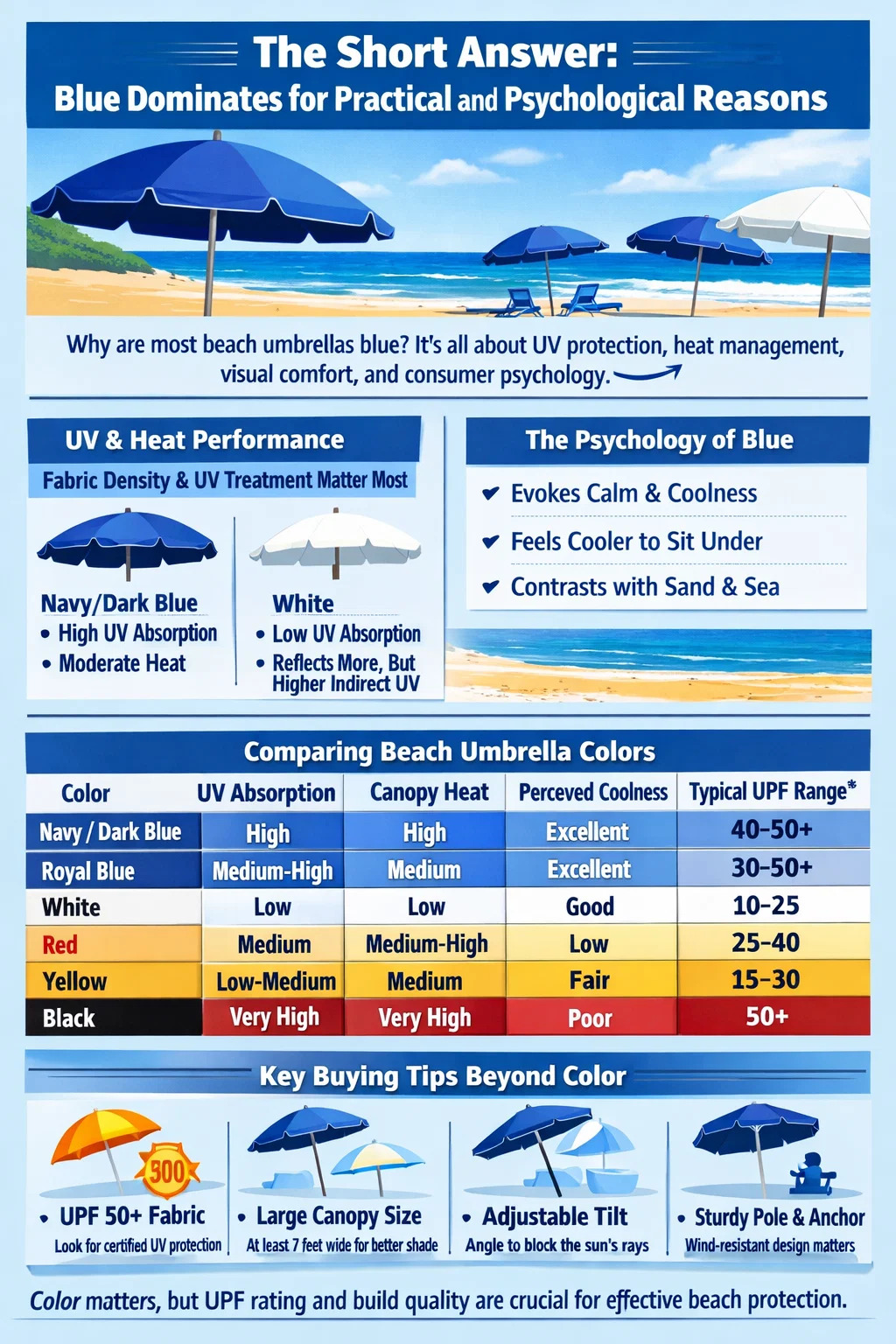
The Short Answer: Blue Dominates for Practical and Psychological Reasons
Walk along any beach — from Miami to the Mediterranean — and you will notice that blue is by far the most common color for beach umbrellas. This is not random. Blue beach umbrellas became dominant because of a combination of UV radiation management, thermal performance, visual comfort, and commercial convention that built up over decades. But color alone does not tell the whole story. The fabric weave, coating technology, and canopy diameter matter just as much as the shade you pick off the rack.
To understand why blue became the go-to for beach umbrellas, you need to look at how colors interact with sunlight, how the human eye responds to outdoor environments, and what manufacturers discovered about customer psychology when selling seasonal shade products.
How Color Affects UV and Heat Under a Beach Umbrella
One of the most persistent myths about beach umbrellas is that a white canopy offers the best sun protection because it reflects light. In reality, the relationship between color, UV transmission, and heat retention is more nuanced than simple light-versus-dark logic.
UV Blocking Is About Fabric Density, Not Just Color
Research published in dermatology journals consistently shows that fabric weave density and thread count are the primary drivers of UPF (Ultraviolet Protection Factor) ratings, not the pigment used. A loosely woven white polyester canopy can have a UPF as low as 10, while a tightly woven dark blue or navy canopy with a UV-blocking treatment can reach UPF 50+. The color contributes to UV absorption — darker pigments absorb more UV photons — but the structure of the material is what actually determines how much radiation passes through to the person sitting underneath.
That said, blue pigments — particularly navy and royal blue — do absorb a meaningful portion of UV-A and UV-B radiation before it reaches the underside of the canopy. Studies on textile UV performance indicate that medium-to-dark blue fabrics can absorb 20–30% more UV radiation than white fabrics of identical weave, which translates to a measurable reduction in reflected UV exposure for users sitting beneath.
Heat Reflection vs. Heat Absorption
Dark colors absorb more heat — this part of physics is straightforward. A black canopy sitting in direct sun will become significantly hotter than a white one. But beach umbrella users are not typically touching the top surface; they care about the temperature in the shade beneath. Here, the dynamic shifts.
Medium-blue canopies strike a balance: they absorb enough solar energy to prevent excessive transmission through the fabric, while not accumulating so much heat that the canopy radiates uncomfortably back down. Very light colors like white or yellow reflect more solar energy upward but also allow more diffuse UV scatter to penetrate, which means people sitting beneath a white beach umbrella still receive indirect UV exposure bouncing off surrounding sand and water.
Sand reflectivity (albedo) averages between 15% and 40% depending on grain size and moisture, while ocean water surfaces can reflect 5–10% of incoming radiation. This ambient UV environment means that even a well-shaded spot on the beach involves indirect radiation, and a canopy with stronger UV absorption — like medium blue — reduces the total radiation budget more effectively than a purely reflective white option.
The Psychology Behind Blue: Why It Feels Right at the Beach
Color psychology plays a significant role in product design, and the beach umbrella market is no exception. Consumer research in outdoor leisure products consistently finds that blue evokes coolness, calm, and relaxation — associations that align directly with what someone wants to feel when they are sitting on a hot beach.
In studies on thermal perception, people sitting under blue-tinted light or blue-colored structures report feeling cooler than those under red or orange structures, even when the actual temperature is identical. This psychophysiological effect is not trivial — it influences purchasing behavior. Retailers and beach rental operations noticed decades ago that blue beach umbrellas sold and rented faster than red or yellow alternatives, which reinforced blue as the default stocking color across wholesale chains.
Blue also contrasts naturally against sand (tan/beige), skin tones, and green beach vegetation, making it visually comfortable. A canopy that blends poorly with its environment creates visual noise; blue creates a coherent, relaxing focal point. This is why resort hotels almost universally stock blue or white beach umbrellas for their beach setups — both colors photograph well, reinforce brand aesthetics of cleanliness and luxury, and do not visually clash with ocean and sky backgrounds.
Color as a Market Convention
Once a color becomes standard in a category, supply chains self-reinforce around it. Manufacturers produce more blue canopies because distributors order more blue ones, because consumers expect blue when they walk into a beach supply store. This does not mean blue is scientifically optimal in every measurable way — it means blue reached a tipping point of cultural association and commercial expectation that makes it difficult to displace.
The same pattern played out with other product categories: yellow school buses, red fire hydrants, green highway signs. Color conventions stabilize around early adoption, psychological association, and supply chain momentum. For beach umbrellas, blue hit all three.
Comparing Beach Umbrella Colors: What the Data Actually Shows
To make color comparisons concrete, here is a breakdown of how common beach umbrella colors perform across key criteria relevant to outdoor sun protection:
| Color | UV Absorption | Canopy Surface Heat | Perceived Coolness | Visual Comfort on Beach | Typical UPF Range* |
|---|---|---|---|---|---|
| Navy / Dark Blue | High | High | High | Excellent | 40–50+ |
| Royal Blue | Medium-High | Medium | High | Excellent | 30–50+ |
| White | Low | Low | High | Good | 10–25 |
| Red | Medium | Medium-High | Low | Fair | 25–40 |
| Yellow | Low-Medium | Medium | Low | Fair | 15–30 |
| Black | Very High | Very High | Low | Poor | 50+ |
The table illustrates why blue sits in a sweet spot: it offers strong UV absorption without the psychological and thermal downsides of black, and it delivers a perception of coolness that neither red nor yellow can match in a beach setting.
What Actually Matters More Than Color When Choosing Beach Umbrellas
The color of your beach umbrella matters, but it is not the most important variable in sun protection performance. Several technical specifications outrank color when it comes to real-world UV defense.
Canopy Diameter and Tilt Mechanism
A 2020 study from the University of Valencia found that beach umbrella diameter was the single strongest predictor of UV exposure reduction for users seated beneath. Umbrellas with canopy diameters of 7 feet (approximately 213 cm) or larger reduced total UV exposure by 77–94% compared to direct sun exposure, while 6-foot canopies reduced exposure by 60–78%. The shade coverage area grows with the square of the radius, meaning small diameter increases deliver disproportionately large protection gains.
Tilt mechanisms also matter substantially. A fixed vertical umbrella on a beach with the sun at a 45-degree angle leaves legs and feet exposed to direct radiation. Umbrellas with cantilever or multi-angle tilt allow the canopy to be positioned perpendicular to the sun's angle, maximizing shade coverage throughout the day.
Fabric Material and UPF Certification
Beach umbrella canopies are typically made from polyester, nylon, acrylic, or olefin fabrics. Each has different baseline UV transmission characteristics before color is factored in:
- Solution-dyed acrylic (such as Sunbrella brand fabric) is widely regarded as the best-performing standard for beach umbrellas — the pigment is integrated into the fiber during production, which prevents UV degradation of the dye and maintains UPF ratings over years of outdoor exposure.
- Coated polyester is common in budget beach umbrellas; UV performance degrades faster as surface coatings break down from repeated sun and moisture exposure.
- Olefin is naturally resistant to moisture and UV degradation, making it durable for beach environments, though it is less common in consumer-grade umbrellas.
Any beach umbrella marketed for sun protection should carry a UPF 50+ certification from a recognized testing standard (such as AS/NZS 4399 or ASTM D6603). A UPF 50+ rating means the fabric allows less than 2% of UV radiation to pass through — a meaningful standard that no color alone can guarantee without the right material.
Pole Stability and Wind Resistance
This is frequently overlooked in discussions about beach umbrella performance. A 2021 report from the U.S. Consumer Product Safety Commission recorded over 2,800 emergency room visits annually in the United States related to beach umbrella injuries, with the majority caused by umbrellas becoming airborne in wind. The pole material (steel versus aluminum versus fiberglass), the anchoring depth in sand, and vented canopy designs (which allow wind to escape through a mesh vent in the top) directly affect whether an umbrella stays in place at beach wind speeds of 15–25 mph, which are common in coastal environments.
Do Different Shades of Blue Perform Differently?
Yes — and the differences are worth understanding if you are comparing specific products.
Navy blue contains higher pigment density and absorbs UV radiation across a broader wavelength range than lighter sky blue. In fabric testing, navy fabrics of equivalent weave consistently outperform lighter blue shades in UV absorption by roughly 10–15 UPF points.
Royal blue (a medium saturated blue) balances UV performance with lower canopy surface temperatures than navy, making it a popular middle-ground choice for beach umbrellas aimed at comfort-focused buyers.
Light blue or sky blue offers lower UV absorption than darker blue variants but retains much of the psychological coolness benefit and visual appeal associated with the color family. For casual beach use where UV protection is supplemented with sunscreen and clothing, light blue canopies perform adequately.
Striped blue-and-white canopies — a classic beach aesthetic derived from traditional European cabana and seafront culture — perform somewhere between solid blue and solid white, depending on the ratio of colors and the underlying fabric quality.
The History of Blue in Beach Culture and Outdoor Shade
The association between blue and beach environments has roots in both practical history and cultural evolution. Early mass-market beach umbrellas in the mid-20th century were produced from canvas and cotton, which were naturally available in limited dye options. Blue dyes — particularly indigo-derived pigments — were among the most stable and colorfast options for outdoor textiles in pre-synthetic-dye eras, resisting fading from repeated sun and salt water exposure better than many other pigments.
European beach resorts along the French Riviera and Italian Adriatic coast popularized the blue-and-white stripe aesthetic in the 1920s and 1930s, connecting blue beach umbrellas visually with aspirational leisure culture. This aesthetic spread globally through travel photography, film, and eventually advertising throughout the 20th century.
By the 1970s and 1980s, when synthetic polyester canopies became the manufacturing standard and full-spectrum dye options became commercially accessible, blue had already established such strong cultural association with beach environments that it remained the default choice despite the availability of any color the market could produce.
Today, blue remains the top-selling color category for beach umbrellas in North America, Europe, and Australia, consistently outselling red, yellow, green, and multicolor options in retail data from outdoor leisure equipment categories.
Practical Buying Guide: Choosing the Right Beach Umbrella
If you are in the market for a beach umbrella and want to make an informed choice rather than simply grabbing the nearest blue one off the shelf, prioritize these factors in order:
- UPF rating: Look for UPF 50+ on the label. Anything below UPF 30 is not adequate for prolonged beach exposure, particularly for fair-skinned individuals or children.
- Canopy diameter: Choose at least 7 feet for a single person, 8–9 feet for two adults. Larger canopies cost more but deliver significantly more shade coverage.
- Canopy material: Solution-dyed acrylic offers the best long-term UV resistance. Coated polyester is acceptable for occasional use but degrades faster.
- Tilt mechanism: Adjustable tilt is worth the added cost for full-day beach use, as the sun's angle changes significantly from morning to afternoon.
- Vented canopy: A wind vent at the top of the canopy reduces the risk of the umbrella becoming airborne in coastal winds.
- Pole and anchor: Fiberglass poles resist corrosion in salt environments better than steel. A sand anchor or corkscrew spike provides more stability than a simple push-in pole.
- Color: Medium to dark blue, navy, or any similar dark saturated color gives you a practical edge in UV absorption. But if you prefer another color, invest in a higher UPF-rated fabric to compensate.
A Note on Umbrella Placement
Even the best beach umbrella cannot compensate for poor positioning. Sand and water reflection means UV exposure continues from ground level and angles not covered by the canopy. Dermatologists recommend supplementing umbrella shade with SPF 30+ sunscreen on exposed skin, protective clothing for children, and repositioning the umbrella as the sun moves to maintain direct shade coverage throughout the day.
Frequently Asked Questions About Beach Umbrella Colors
Does a darker beach umbrella protect better from the sun?
Generally, yes — darker colors absorb more UV radiation and allow less to pass through the canopy. However, the difference between a dark blue and a medium blue canopy of identical material and UPF certification is small in practice. A high-quality light-colored canopy with UPF 50+ will outperform a dark-colored low-quality canopy every time. Focus on the UPF rating and fabric quality first.
Are white beach umbrellas less protective than blue ones?
White canopies reflect more UV than they absorb, which means more UV passes through to the user compared to a dark blue canopy of identical construction. For beach environments, where ambient UV from sand and water reflection adds to direct overhead UV, a white canopy's lower absorption can result in meaningfully higher indirect UV exposure. That said, a well-constructed white solution-dyed acrylic canopy with UPF 50+ still provides excellent protection — just ensure the rating is independently certified.
Can a beach umbrella replace sunscreen?
No. Beach umbrellas reduce but do not eliminate UV exposure. Studies show that even under a properly positioned UPF 50+ beach umbrella, users still receive UV exposure from ground reflection, atmospheric scatter, and canopy edges. Sunscreen, protective clothing, and umbrellas work best as a combined system — not as standalone alternatives to each other.
Why do rental beach umbrellas almost always come in blue or white?
Beach rental operations choose blue and white for a combination of reasons: these colors photograph attractively against beach backdrops, they are perceived as neutral and universally acceptable (unlike red or yellow, which some guests find visually aggressive), they show less visual dirt and staining over a season of heavy use, and they are consistently the most requested colors in customer surveys for beach amenities.
How long does a beach umbrella's UV protection last?
UV protection in beach umbrella canopies degrades over time, particularly in cheaper coated fabrics. Solution-dyed acrylic canopies (like those made with Sunbrella fabric) maintain their UPF ratings for 5–10 years under regular use when rinsed clean and stored dry between uses. Coated polyester canopies may lose significant UV protection within 2–3 seasons of heavy beach exposure. Fading of the canopy color is a visual indicator that UV degradation may be occurring, though the correlation is not perfect — test UPF periodically if you rely on an older umbrella for serious sun protection.
Recommended products
Contact Us Now
Copyright 2024 @ Shaoxing Jinqiao Umbrella Co., Ltd. All Rights Reserved. OEM/ODM umbrellas manufacturers Custom Umbrellas Factory
