

 English
 中文简体
中文简体






7ft vs 8ft Beach Umbrella: Which Size Is Actually Better?
Posted by Admin
Content
- 1 The Short Answer: 8ft Wins for Families, 7ft Wins for Solo Travelers
- 2 Understanding What "7ft" and "8ft" Actually Means
- 3 Shade Coverage Comparison: How Much Space Do You Actually Get?
- 4 Wind Resistance and Stability: Bigger Is Not Always Safer
- 5 Portability and Weight: The Real Trade-Off Between Sizes
- 6 UPF Rating and UV Protection: Size Does Not Determine Safety
- 7 Price Difference and Value for Money
- 8 Who Should Buy a 7ft Beach Umbrella
- 9 Who Should Buy an 8ft Beach Umbrella
- 10 Pole Material: What to Look for in Either Size
- 11 Top-Rated Models to Consider in Both Sizes
- 12 Practical Tips for Getting the Most Out of Any Beach Umbrella
- 13 Final Verdict: The Size That Works for Most People
The Short Answer: 8ft Wins for Families, 7ft Wins for Solo Travelers
If you are shopping for a beach umbrella and wondering whether 7ft or 8ft is the better choice, here is the direct answer: an 8ft beach umbrella is better for groups of 3 or more people, while a 7ft umbrella is a smarter pick for individuals or couples who prioritize portability. The difference in canopy diameter between these two sizes translates into a meaningful gap in usable shade — and that gap matters when you are trying to keep your whole family cool on a hot summer afternoon.
That said, the right choice depends on more than just headcount. Wind conditions, sand anchor depth, carry bag weight, and how far you hike from the parking lot all factor into which umbrella will actually serve you better. This guide breaks down every relevant dimension so you can make a confident decision before your next beach day.
Understanding What "7ft" and "8ft" Actually Means
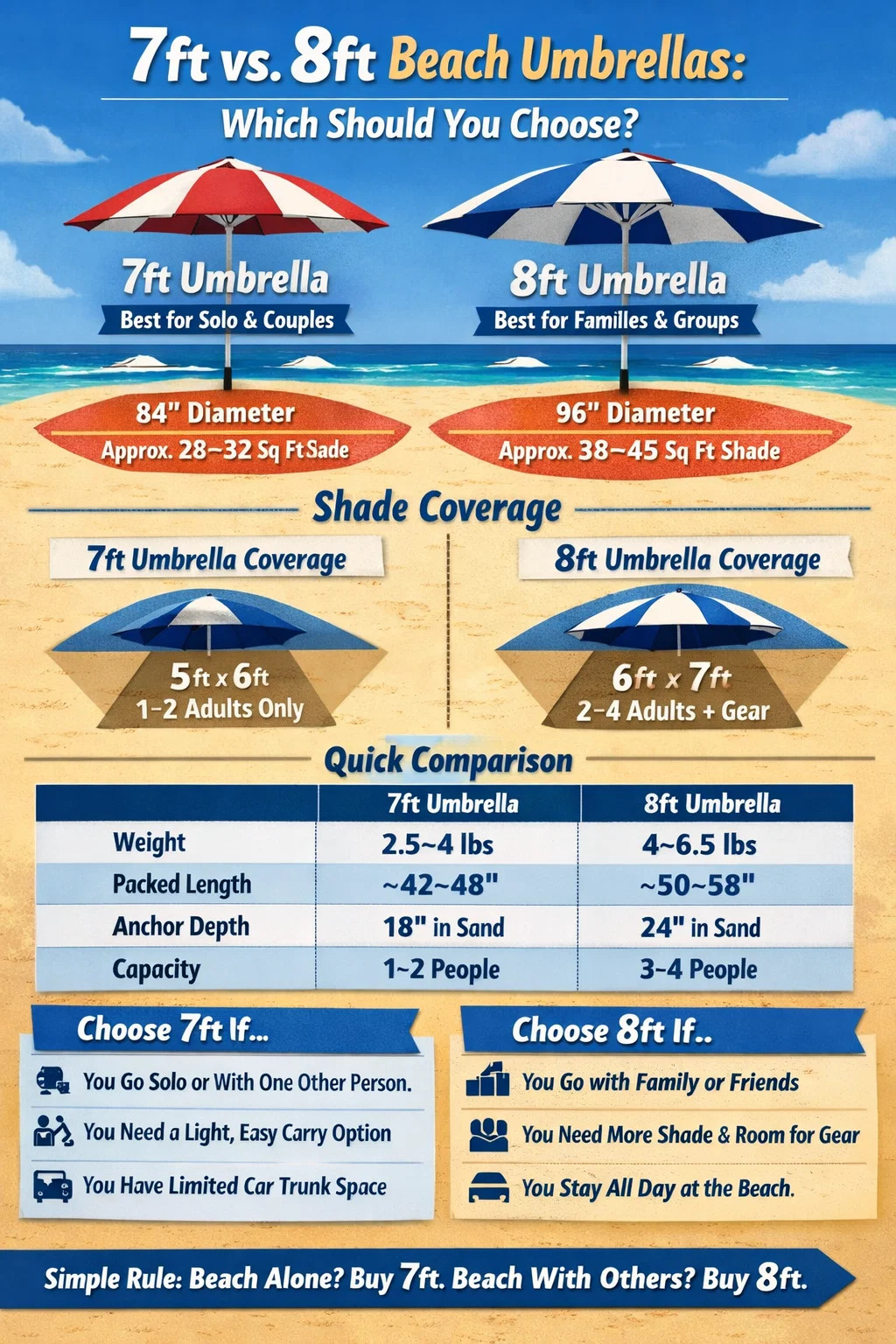
When a beach umbrella is labeled as 7ft or 8ft, that measurement refers to the diameter of the canopy when fully opened — not the pole length, not the height from the ground. This distinction matters because the actual shade footprint on the sand is smaller than the canopy diameter once you account for the angle of the sun and the tilt of the pole.
Here is a practical breakdown of what each size delivers in real-world shade coverage:
| Umbrella Size | Canopy Diameter | Approx. Shade Area | Comfortable Capacity | Typical Weight |
|---|---|---|---|---|
| 7ft | 84 inches | ~28–32 sq ft | 1–2 adults | 2.5–4 lbs |
| 8ft | 96 inches | ~38–45 sq ft | 2–4 adults | 4–6.5 lbs |
The jump from 7ft to 8ft adds roughly 10 to 13 square feet of shade — enough room for an extra beach chair and a cooler. That might not sound dramatic on paper, but when you are lying on your back and trying to keep your legs out of direct midday sun, those extra inches make a tangible difference.
Shade Coverage Comparison: How Much Space Do You Actually Get?
Shade coverage is the single most important factor when choosing between a 7ft and an 8ft beach umbrella. Let's be specific about what each size realistically covers.
7ft Beach Umbrella Coverage
A 7ft umbrella with a properly tilted pole will shade a roughly 5ft × 6ft rectangle on the sand at peak sun hours. That is enough space for one standard beach lounger and a small bag. Two adults can share the shade if they are lying close together, but there is little room for gear, a cooler, or children's toys. If you are a solo beachgoer who reads or naps under the umbrella, a 7ft model gives you all the coverage you need without the extra weight and bulk.
8ft Beach Umbrella Coverage
An 8ft umbrella casts a shade patch closer to 6ft × 7ft when tilted toward the sun. That comfortably fits two side-by-side loungers with a small buffer, or three beach chairs arranged in a cluster. Families with young children can shade the adults' chairs and a small play area simultaneously. The 8ft size is the most popular choice for family beach trips, and it shows in the product lineup — the majority of heavy-duty beach umbrella models sold on Amazon and at retailers like REI and Target are offered in the 8ft configuration.
The Sun Angle Factor
No matter which size you choose, shade coverage shrinks significantly in the morning and late afternoon when the sun sits lower on the horizon. A properly tilted umbrella compensates for this — most quality beach umbrellas have a tilt mechanism that lets you angle the canopy up to 30–45 degrees. If you tend to beach in the early morning or late afternoon, the extra canopy of an 8ft model becomes even more valuable because the effective shade patch at low sun angles is always smaller than at midday.
Wind Resistance and Stability: Bigger Is Not Always Safer
Wind is one of the most underestimated dangers at the beach. According to the U.S. Consumer Product Safety Commission, beach umbrella injuries serious enough to require emergency room treatment number in the hundreds each year, and the majority involve umbrellas that became airborne in wind gusts. Size plays a direct role in this risk.
Why Larger Canopies Catch More Wind
A larger canopy presents more surface area to the wind. An 8ft umbrella has approximately 30% more canopy area than a 7ft model, which means it catches significantly more force in a gust. This does not make the 8ft umbrella inherently unsafe, but it does mean that proper anchoring becomes more critical. A 7ft umbrella staked 18 inches into the sand may be adequately secure, while an 8ft umbrella under the same conditions might need to go 24 inches deep to achieve the same stability.
Anchor Depth Recommendations by Size
- 7ft beach umbrella: Minimum 18 inches into compacted wet sand; use a sand anchor screw for soft dry sand.
- 8ft beach umbrella: Minimum 24 inches for most conditions; in winds above 15 mph, consider a secondary anchor bag weighted with sand placed over the base.
Many popular 8ft models — such as the Sport-Brella XL, the Tommy Bahama 8ft umbrella, and the Blissun 8ft beach umbrella — come with spiral-tip poles specifically designed for deeper penetration into sand. This helps offset the larger wind load. If you are shopping for an 8ft model, prioritize one with a spiral or corkscrew tip pole rather than a straight spike.
Vented Canopy Design
Both 7ft and 8ft umbrellas are available with double-vented canopy designs, where a small gap between two canopy layers allows wind to pass through rather than lifting the entire umbrella. If you beach at locations known for afternoon wind — such as along the Outer Banks, the Jersey Shore, or California's coastal beaches — a vented canopy is worth paying extra for regardless of which size you choose. A vented 8ft umbrella is safer in wind than a non-vented 8ft model, and often safer than a non-vented 7ft umbrella as well.
Portability and Weight: The Real Trade-Off Between Sizes
For many beachgoers, especially those who park far from the water or take ferry trips to island beaches, the weight and packability of a beach umbrella matters as much as its shade coverage.
Weight Difference in Practice
A typical 7ft beach umbrella weighs between 2.5 and 4 pounds. An 8ft model generally weighs between 4 and 6.5 pounds, with heavy-duty options with fiberglass poles reaching up to 8 pounds. That 2–3 pound difference might seem small, but consider that you are also carrying a cooler, chairs, towels, and bags. Over a 10-minute walk through soft sand, every extra pound registers in your arms and shoulders.
Here is how the two sizes compare across portability factors:
| Factor | 7ft Umbrella | 8ft Umbrella |
|---|---|---|
| Average weight | 2.5–4 lbs | 4–6.5 lbs |
| Packed length | ~42–48 inches | ~50–58 inches |
| Fits in standard trunk | Almost always | Sometimes awkward |
| One-handed carry | Easy | Manageable |
| Carry bag included | Usually yes | Usually yes |
Pole Length and Car Storage
Many 8ft beach umbrellas break down into a two-section pole that packs to around 50–54 inches. This fits diagonally in most car trunks but can be awkward in compact cars. Some models use a three-section pole that packs shorter, making them much easier to transport. If you drive a smaller vehicle, check the packed dimensions before buying any 8ft model — this is a detail that often causes buyer regret.
UPF Rating and UV Protection: Size Does Not Determine Safety
One area where 7ft and 8ft beach umbrellas perform identically — assuming comparable fabric — is UV protection. The UPF (Ultraviolet Protection Factor) rating of a beach umbrella depends on the fabric type, weave density, and color, not the canopy size.
Look for UPF 50+ on any beach umbrella you buy, regardless of size. A UPF 50+ rating means the fabric blocks over 98% of UV radiation. For context, a regular white cotton T-shirt has a UPF of roughly 5. Cheaper beach umbrellas sometimes use thin polyester with no UPF rating at all — these block sunlight visually but offer far less UV protection than they appear to.
Darker canopy colors — navy, black, forest green — generally offer better UV blocking than lighter colors like white or yellow, because the dye adds another layer of UV absorption. Silver or aluminum-coated canopies, which reflect rather than absorb UV, can also achieve excellent UPF ratings.
A dermatology study published in JAMA Dermatology found that beach umbrellas alone — even high-UPF models — do not fully protect against UV exposure due to reflected UV from sand and water. Researchers recommend using sunscreen in addition to an umbrella, not instead of it. This applies equally to both 7ft and 8ft umbrellas.
Price Difference and Value for Money
The price gap between 7ft and 8ft beach umbrellas is generally modest, but it varies by brand tier:
- Budget range (under $30): Most budget umbrellas are sold as 7ft models. 8ft models exist at this price point but typically use thinner fabric and lighter poles that compromise durability.
- Mid-range ($30–$70): Both sizes are widely available with decent fabric quality and fiberglass or aluminum poles. The 8ft version usually costs $10–$20 more than the 7ft equivalent in the same product line.
- Premium ($70–$150+): Brands like Tommy Bahama, BeachBub, and EasyGo offer heavy-duty 8ft models with reinforced canopies, full-length carry bags with shoulder straps, and sand anchor systems. At this price point, the 8ft size dominates because buyers are investing for family use.
For most buyers, spending $15–$20 more to move from a 7ft to an 8ft model in the same product line is worth it if you beach with anyone other than yourself. The extra shade coverage delivers more practical value per dollar than almost any other upgrade you can make to your beach setup.
Who Should Buy a 7ft Beach Umbrella
A 7ft beach umbrella is the right choice for a specific type of beachgoer. You will get the most out of this size if:
- You go to the beach alone or with one other person and do not need to shade more than two chairs at once.
- You walk a significant distance to reach the water from your car or transit stop, and weight is a concern.
- You fly to beach destinations and want to pack a beach umbrella in checked luggage — a compact 7ft model fits more easily in a duffel bag or luggage tube.
- You use the umbrella primarily to shade your face and upper body while reading, not to cover your entire setup.
- You go to crowded beaches where spacing between setups is tight and a large 8ft canopy would overlap with your neighbors.
- You have a compact car or motorcycle and need the umbrella to pack down small.
The 7ft size is also a solid entry point if you are buying a beach umbrella for the first time and are not yet sure how much shade coverage you actually need. It is far more useful than going without an umbrella, and upgrading later is always an option.
Who Should Buy an 8ft Beach Umbrella
An 8ft beach umbrella earns its extra size and weight in these situations:
- You go to the beach with your family — especially with young children who need to stay out of the sun for extended periods.
- You set up for a full day and want to shade two loungers, a cooler, and a bag without anyone's legs poking out into direct sun.
- You or someone in your group has sun sensitivity, a history of skin cancer, or a medical reason to avoid UV exposure — more canopy means more consistent protection.
- You beach in the afternoon when the sun is lower and the shade footprint shrinks — a larger canopy compensates for the lower sun angle.
- You drive to the beach and can park close enough that carrying a slightly heavier umbrella is not a burden.
- You want the umbrella to double as a wind break or privacy screen on a crowded beach.
In short, if you beach with other people more than half the time, buy the 8ft. The extra coverage is the kind of practical upgrade that you will appreciate every single time you use it.
Pole Material: What to Look for in Either Size
Whether you choose a 7ft or 8ft beach umbrella, the pole material significantly affects durability, weight, and wind resistance. There are three main materials on the market:
Steel Poles
Steel poles are the heaviest option — often adding a full pound or more compared to aluminum. They are strong and resist bending in moderate wind, but they are prone to rust when the coating is scratched, which is almost inevitable with regular sand and saltwater exposure. Generally found only on budget models and not recommended for regular use near salt water.
Aluminum Poles
Aluminum strikes the best balance of weight, strength, and corrosion resistance for most beachgoers. A quality aluminum pole on an 8ft umbrella typically weighs 1–1.5 lbs less than a comparable steel pole while offering better rust resistance. Aluminum is the material to choose for most buyers who want durability without excessive weight.
Fiberglass Poles
Fiberglass is lighter than steel and more flexible than aluminum, which gives it an advantage in one specific scenario: high winds. A fiberglass pole bends rather than snaps under wind load, which means it is less likely to break and less likely to become a safety hazard in a sudden gust. Many premium 8ft beach umbrellas use fiberglass ribs on the canopy spokes (even with aluminum poles) to add flexibility at the canopy edge where stress is highest. If you beach frequently in windy conditions, look for fiberglass ribs or a full fiberglass pole in whichever size you choose.
Top-Rated Models to Consider in Both Sizes
To make this comparison more concrete, here are well-regarded beach umbrella options in each size category as of 2024:
7ft Models Worth Considering
- AmazonBasics Beach Umbrella (7ft): A no-frills option around $25–$30. Good for occasional use, lightweight at 3 lbs, but the fabric has no listed UPF rating — a notable weakness.
- Blissun 7ft Beach Umbrella: UPF 50+, tilt mechanism, aluminum pole, around $35–$45. One of the best value options in the 7ft category with solid customer reviews for durability.
- Sport-Brella Versa-Brella (7ft): A unique design with a universal clamp mount that attaches to chairs or poles rather than planting in sand. Practical for rocky beaches or boat decks where staking is not possible.
8ft Models Worth Considering
- Tommy Bahama 8ft Beach Umbrella: One of the most recognized names in beach umbrellas. UPF 50+, tilt and swivel base, carry bag included, around $50–$70. Consistently strong reviews for build quality and ease of use.
- BeachBub All-In-One Beach Umbrella System (8ft): Premium option around $100–$130. Includes a weighted base bag, spiral anchor, carry bag with wheels, and a 400-denier nylon canopy rated UPF 50+. One of the most stable 8ft systems available for windy conditions.
- EasyGo Products Hurricane (8ft): Features a double vented canopy specifically designed for wind resistance, tested up to 40 mph. Fiberglass ribs, UPF 50+, around $60–$80. Best choice if wind is your primary concern.
- Sport-Brella XL (8ft): A hybrid design with side wings that extend coverage beyond the canopy. Good for families who want additional side shade, around $70–$90.
Practical Tips for Getting the Most Out of Any Beach Umbrella
Regardless of whether you choose a 7ft or 8ft model, these practices will improve both the shade coverage and safety of your setup:
- Use wet sand. Anchor your umbrella in the damp sand closer to the water line, not in dry loose sand. Wet sand compacts around the pole and holds it far more securely. If you must anchor in dry sand, use a screw-in sand anchor — many can be found for under $15 and add meaningful stability.
- Tilt toward the sun, not just straight up. A vertical umbrella provides the least shade coverage because the shadow falls directly underneath. Tilting the canopy to face the sun extends the shadow significantly and keeps everyone shaded even as the sun moves across the sky.
- Never leave an unsecured umbrella unattended. If you go for a swim or leave your setup, close the canopy or remove the umbrella from the sand. A closed canopy catches almost no wind and eliminates the risk of it becoming airborne while you are in the water.
- Check conditions before setup. If sustained winds are above 20 mph when you arrive, an umbrella — especially an 8ft model — becomes more hazard than help. Under these conditions, a pop-up beach tent or canopy with four sand anchors is a safer choice.
- Rinse and dry before storage. Salt, sand, and moisture accelerate corrosion and fabric degradation. A quick rinse with fresh water and a full dry before packing away dramatically extends the life of any beach umbrella.
Final Verdict: The Size That Works for Most People
When you weigh all the factors — shade coverage, wind safety, portability, price, and real-world use cases — the 8ft beach umbrella is the better choice for most people. It provides enough shade for the way most people actually use a beach umbrella: with at least one other person, on a warm day, for several hours. The extra weight and slight price premium are easy trade-offs to accept when you consider how much more comfortable your setup will be.
The 7ft umbrella remains the right tool for solo travelers, people who hike to remote beaches, or anyone who genuinely prioritizes portability over coverage. It is not a lesser product — it is a different tool for a different set of needs.
If you are still undecided, use this simple rule: if you beach alone, buy 7ft; if you beach with others, buy 8ft. Both sizes, when properly anchored and equipped with a UPF 50+ canopy, will give you a safer and more comfortable day at the beach than going without an umbrella at all.
Recommended products
Contact Us Now
Copyright 2024 @ Shaoxing Jinqiao Umbrella Co., Ltd. All Rights Reserved. OEM/ODM umbrellas manufacturers Custom Umbrellas Factory
