

 English
 中文简体
中文简体






How deep should a beach umbrella be?
Posted by Admin
Content
- 1 Why Beach Umbrella Depth Is a Safety Issue, Not Just a Comfort One
- 2 The Minimum Depth Rule and When to Exceed It
- 3 How Sand Type Changes the Depth Calculation
- 4 The Correct Technique for Reaching the Right Depth
- 5 How Pole Diameter Affects Grip at Any Depth
- 6 Sand Anchors: When Depth Alone Isn't Enough
- 7 The Role of Insertion Angle in Working With Depth
- 8 How Often to Recheck Depth Throughout the Day
- 9 Depth Requirements for Different Beach Umbrella Sizes
- 10 Measuring Depth Without a Ruler
- 11 Depth vs. Other Stability Factors: Getting the Balance Right
- 12 Special Situations: Rocky Beaches, Hard Ground, and Shallow Sand Over Rock
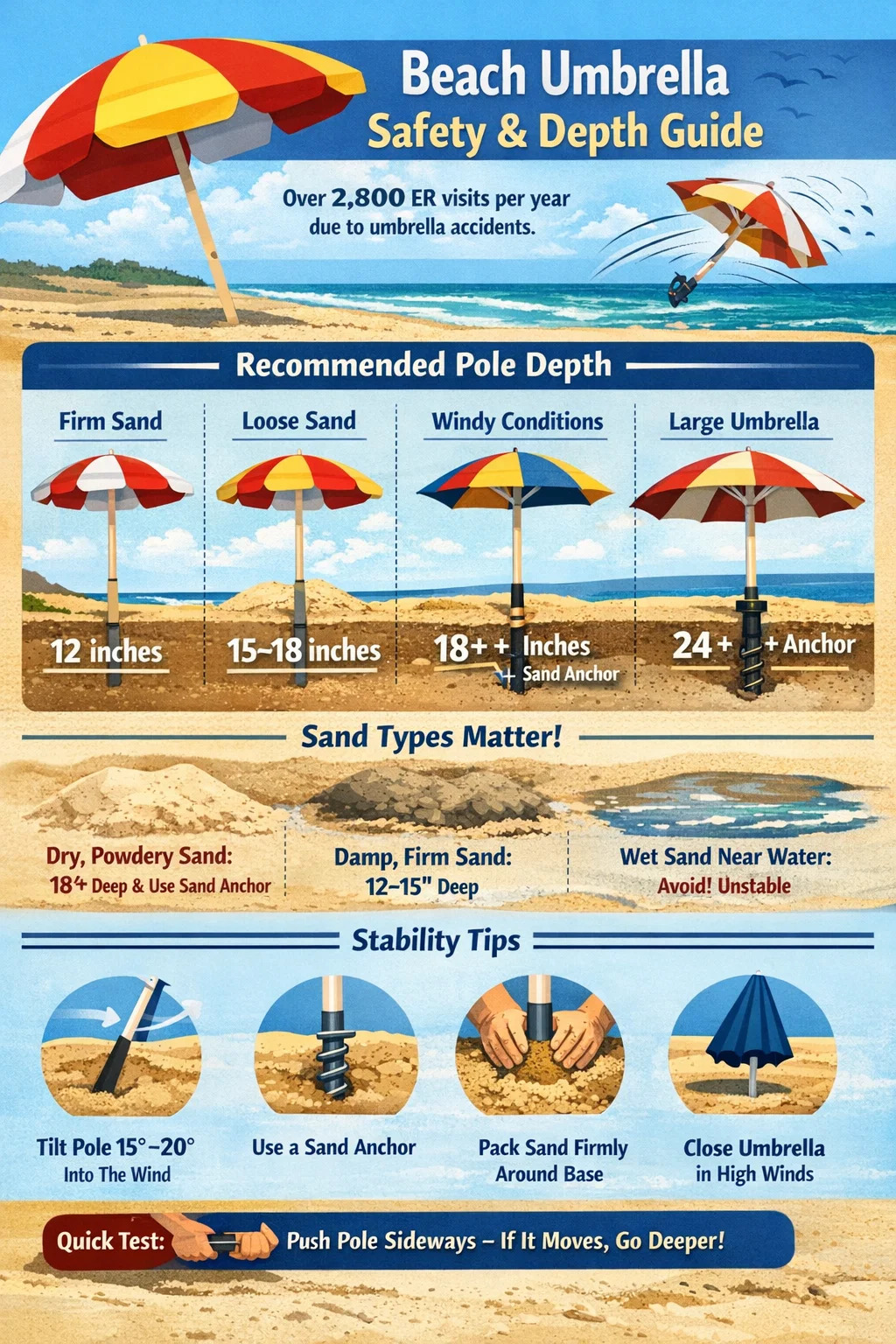
A beach umbrella pole should be inserted at least 12 inches (30 cm) into the sand — and ideally 18 inches (45 cm) or deeper in loose, dry, or powdery sand conditions. That's the baseline answer. The exact depth you need depends on sand type, wind speed, pole diameter, and whether you're using a sand anchor. Too shallow and your beach umbrella becomes a projectile risk; too deep and you're wasting effort that could go into proper angling instead.
This article breaks down exactly why depth matters, how to achieve it in different sand conditions, and what else affects stability so you're not relying on depth alone to keep your setup safe.
Why Beach Umbrella Depth Is a Safety Issue, Not Just a Comfort One
The Consumer Product Safety Commission estimates that beach umbrella injuries send over 2,800 people to US emergency rooms every year. The majority of incidents involve umbrellas that were either too shallow in the sand or angled incorrectly relative to the wind — both of which cause the umbrella to tip, roll, or become airborne. A 7-foot beach umbrella weighing 4–6 lbs traveling in a 25 mph wind gust carries enough force to cause serious injuries to anyone it strikes.
Depth is your primary line of defense. The pole buried in the sand acts as a fulcrum anchor. Wind pushes laterally against the canopy, creating a rotating force (torque) around the point where the pole enters the sand. The deeper the pole goes, the longer the buried lever arm working against that torque — which is why an extra 4–6 inches of depth can double resistance to tipping in some sand conditions.
The Minimum Depth Rule and When to Exceed It
The widely recommended minimum of 12 inches applies under average beach conditions: moderately compact sand, light to gentle breezes (under 10 mph), and a standard 6–7.5 foot beach umbrella. In real-world conditions, you'll often need to go deeper.
| Condition | Sand Type | Recommended Depth | Additional Measure |
|---|---|---|---|
| Calm (0–10 mph) | Firm/packed | 12 inches | Standard setup |
| Calm (0–10 mph) | Loose/dry | 15–18 inches | Pack sand around base |
| Moderate (10–20 mph) | Any | 18 inches | Use sand anchor |
| Strong (20–30 mph) | Any | 18+ inches | Sand anchor + consider closing canopy |
| High wind (30+ mph) | Any | Do not use | Close and secure umbrella |
One practical test that works regardless of depth measurement: once you've inserted the pole, grab it with both hands and push sideways with moderate force. If the pole moves more than about one inch under that pressure, it's not deep enough — go further before opening the canopy. This test takes five seconds and catches inadequate depth every time.
How Sand Type Changes the Depth Calculation
Not all beach sand behaves the same. The grain size, moisture content, and compaction level of sand dramatically affect how much grip it provides around a pole at any given depth.
Fine, Dry, Powdery Sand
This is the hardest sand type for securing a beach umbrella. Fine grains flow around the pole freely, providing minimal lateral resistance. In this condition, 12 inches is genuinely insufficient for anything beyond perfectly calm days. Target 18 inches minimum, use a sand anchor, and pack extra sand firmly around the base after insertion. Wetting the sand directly around the pole with a cup of seawater can help — as the water is absorbed and partially evaporates, it temporarily increases cohesion between grains and the pole surface.
Firm, Damp, Mid-Beach Sand
This is the ideal sand for securing a beach umbrella. Found above the high-tide line but below the loose dry zone, damp mid-beach sand grips the pole well on all sides. At 12–15 inches in this type of sand, most standard beach umbrellas hold adequately in moderate wind. The moisture acts as a mild adhesive between grains, creating cohesive pressure around the inserted pole.
Wet Sand Near the Waterline
Despite feeling firm underfoot, wet sand close to the surf is unreliable for beach umbrella anchoring. Each wave saturates the sand around your pole, temporarily turning it semi-liquid and releasing grip. Over one to two hours, a pole that felt solid at first can become progressively looser as repeated wave action works the sand around it. Avoid setting up within 50–60 feet of the waterline when possible, and never in active wave wash zones.
Coarse or Gravelly Sand
Beaches with larger grain sizes or mixed sand-gravel surfaces can be tricky. Coarse grains don't pack as tightly around a pole, leaving air gaps that reduce lateral grip. However, coarse sand is also heavier and less prone to shifting in wind, which partially compensates. In coarse sand conditions, prioritize using a sand anchor over simply going deeper — the anchor's screw geometry is far more effective at creating grip in coarse material than additional pole depth alone.
The Correct Technique for Reaching the Right Depth
Depth without proper technique creates problems of its own. Forcing a pole straight down without rotating it compacts a cone of sand beneath the tip rather than displacing it — this creates a loose channel that the pole can slip in rather than a firm grip. The correct insertion method:
- Hold the pole at a 15–20 degree angle toward the prevailing wind before you begin — this is the angle it should maintain once inserted, so establish it from the first contact with the sand.
- Place the pointed tip on the sand surface and apply downward pressure while simultaneously rotating the pole clockwise. This twisting motion displaces sand sideways rather than compressing it downward.
- Use your body weight by leaning into the pole from above — this is more effective than pushing with arm strength alone, and reduces fatigue.
- Stop every 4–5 inches and pack loose sand around the outside of the pole with your hands or heel before continuing. Layering the compaction as you go produces a much tighter fit than simply pushing to depth in one motion.
- Once at target depth, do a final pack of sand at the surface around the pole base, pressing inward from all sides.
- Perform the two-handed lateral push test before opening the canopy.
In very hard-packed sand where hand-twisting is difficult, a T-handle insertion tool (a simple device that threads over the pole and gives more rotational leverage) makes reaching 15–18 inches significantly easier. These sell for $10–$20 at most beach supply retailers.
How Pole Diameter Affects Grip at Any Depth
A wider pole contacts more sand per inch of depth, which means it generates more lateral resistance than a thinner pole at the same insertion depth. Most standard beach umbrella poles measure between 1 inch and 1.5 inches in diameter. High-end heavy-duty beach umbrellas often use 1.5-inch or even 2-inch diameter poles, which noticeably improve stability in sand without requiring additional depth.
A 1.5-inch diameter pole buried 12 inches provides roughly 50% more contact surface area than a 1-inch pole at the same depth — which is why diameter matters nearly as much as depth when evaluating how well a beach umbrella will hold. If you're shopping for a new umbrella and beach in windy conditions regularly, pole diameter is a specification worth checking, not just canopy size.
Sand Anchors: When Depth Alone Isn't Enough
A sand anchor is a separate helical (corkscrew-shaped) device, typically 10–15 inches long and made from aluminum or heavy plastic, that you screw into the sand independently before threading your beach umbrella pole through its center. The anchor's spiral shape creates dramatically more contact with surrounding sand than a smooth pole can achieve — it essentially grips sand from multiple angles simultaneously rather than just laterally.
The combined holding force of a properly installed sand anchor plus a pole inserted 12 inches through it typically exceeds the holding force of a bare pole sunk 24–28 inches in loose sand. That's a meaningful difference when you consider that reaching 24 inches by hand-twisting alone is difficult and time-consuming on most beaches.
How to Install a Sand Anchor Correctly
- Twist the anchor straight down into the sand until the top is flush with or just slightly below the surface — typically 10–12 turns depending on the anchor's thread pitch.
- Thread your umbrella pole through the anchor's center hole before inserting the pole into the ground beneath it.
- Push the pole down through the anchor into the sand below — another 12 inches minimum — at the correct 15–20 degree wind angle.
- Pack sand firmly around the exposed anchor top and pole base.
Sand anchors from reputable brands (AnchorUbrella, Shademate, and similar) cost between $15 and $35. They're reusable for years and are particularly valuable at beaches known for fine or shifting sand — Caribbean-style white sand beaches, for instance, are notoriously difficult to anchor in without one.
The Role of Insertion Angle in Working With Depth
Depth and angle work together — getting one right without the other leaves you vulnerable. A pole inserted 18 inches straight down actually provides less resistance to a crosswind than a pole inserted 14 inches at a 15–20 degree angle into the wind. Here's why: when wind pushes the canopy, it creates a rotating force around the point of sand entry. An angled pole means that force is partially directed deeper into the sand rather than purely sideways. A vertical pole transfers all that lateral wind force directly to the shallowest, weakest point of grip.
The correct setup is always: maximum achievable depth plus a 15–20 degree tilt into the prevailing wind. These aren't competing considerations — they reinforce each other. Never sacrifice one for the other.
Identifying Wind Direction Before You Insert
Wet a finger and hold it up — the cool side faces into the wind. Alternatively, watch how nearby beach umbrellas, flags, or wind socks are angled. Insert the pole at the same side the wind is coming from, so the canopy opens downwind. This way wind flows over the canopy rather than catching it like a cup. A beach umbrella angled away from the wind catches maximum wind force and exits the sand faster than almost any other failure mode.
How Often to Recheck Depth Throughout the Day
Sand conditions and wind patterns shift over a beach day. A setup that was solid at 9 AM can be noticeably looser by early afternoon as sun-dried sand around the pole loses cohesion, or as wave activity creeps closer to your position. Check stability every 60–90 minutes by performing the two-hand lateral push test. If there's any new play in the pole, close the canopy first, then either repack sand around the base or withdraw and reinsert deeper.
Also check immediately after any wind gust strong enough to visibly move the canopy. A single strong gust can work the pole loose by a fraction of an inch — barely perceptible by eye but enough to reduce resistance to the next gust significantly. This cumulative loosening effect is responsible for a large portion of beach umbrella tip-over incidents that happen hours after a setup seemed fine.
What to Do When the Pole Becomes Loose Mid-Day
- Close the canopy before doing anything else. This eliminates wind force on the pole immediately.
- Withdraw the pole fully and pour a small amount of water into the hole — fresh water or seawater both work. Let it soak in for 30 seconds.
- Reinsert the pole using the rotating technique, this time going 2–3 inches deeper than the original depth.
- Pack the surface sand firmly around the base and repeat the stability test before reopening the canopy.
- If the same spot consistently loosens, move 4–6 feet and find a firmer patch of sand rather than fighting the same compromised location.
Depth Requirements for Different Beach Umbrella Sizes
Larger canopies catch more wind. A 9-foot beach umbrella exposes more than twice the canopy area to wind compared to a 6-foot model — which means it generates much greater force on the pole at any given wind speed. Depth requirements scale with umbrella size, and this is a factor many people overlook when setting up large market-style umbrellas on the beach.
| Canopy Diameter | Approx. Canopy Area | Min. Depth (Firm Sand) | Min. Depth (Loose Sand) |
|---|---|---|---|
| 6 feet | ~28 sq ft | 12 inches | 15 inches |
| 7 feet | ~38 sq ft | 14 inches | 18 inches |
| 7.5 feet | ~44 sq ft | 15 inches | 18–20 inches |
| 9 feet | ~64 sq ft | 18 inches | 24 inches + anchor |
For 9-foot or larger beach umbrellas used on sandy beaches, a sand anchor combined with deep insertion is effectively mandatory in any wind above a gentle breeze. These umbrellas were not originally designed for sand anchoring — many are market-style patio umbrellas repurposed for beach use — which is why they require extra attention to secure correctly.
Measuring Depth Without a Ruler
Most people don't bring a tape measure to the beach. These body-measurement references give you a reliable approximation without tools:
- 12 inches: The length from the tip of an average adult's middle finger to the wrist crease. If you can insert your hand alongside the pole to wrist depth, you're at approximately 12 inches.
- 15 inches: The distance from fingertips to mid-forearm on most adults. Use this as a visual reference when estimating how much pole has disappeared below the sand surface.
- 18 inches: Roughly the length from fingertips to the elbow for an average adult. If you can see at least this much of the bottom pole section has vanished below sand level, you're at the right depth.
Alternatively, mark your pole before leaving home. Use a strip of waterproof tape or a permanent marker line at 12 inches and 18 inches from the pointed tip. This takes 30 seconds and eliminates guesswork entirely.
Depth vs. Other Stability Factors: Getting the Balance Right
Depth is necessary but not sufficient for a safe beach umbrella setup. The following factors contribute to overall stability alongside insertion depth:
- Wind angle: Tilting 15–20 degrees into the wind redistributes force vectors in your favor. As noted above, correct angle often matters more than an extra 3–4 inches of depth.
- Sand anchor: Dramatically increases holding force in loose or powdery sand — often the difference between a stable and an unstable setup in challenging conditions.
- Vented canopy design: A top vent on the beach umbrella canopy allows wind to pass through rather than build pressure. In 15–20 mph wind, a vented canopy reduces lateral force on the pole by an estimated 30–40% compared to a solid canopy.
- Canopy open/closed state: A closed canopy generates near-zero wind resistance. Closing the canopy during strong gusts — even temporarily — protects your entire setup from cumulative loosening.
- Location selection: Setting up in the dry mid-beach zone (50–60 feet from the water's edge) rather than at the waterline puts you in consistently firmer, more stable sand regardless of depth.
Think of each factor as a layer of protection. Depth alone at 18 inches in fine sand during a 20 mph wind may not be enough. But 18 inches of depth plus a sand anchor plus a 15-degree wind angle in mid-beach sand during the same wind produces a genuinely secure setup. Stacking these factors is how you stay safe across varying real-world beach conditions.
Special Situations: Rocky Beaches, Hard Ground, and Shallow Sand Over Rock
Some beaches have only a shallow layer of sand over rock, hardpan, or compacted clay — which makes reaching 12–18 inches impossible. In these cases, standard pole insertion simply isn't viable. Options include:
- Weighted base systems: Freestanding umbrella bases filled with sand provide an above-ground anchor. These require a minimum of 30–40 lbs of sand fill to be functional in any meaningful wind. Most portable weighted bases max out around 20–25 lbs when filled with sand at the beach — adequate for calm conditions, marginal in breeze.
- Beach tents instead of umbrellas: Pop-up beach tents with multiple ground stakes spread across a wider footprint and work effectively where pole anchoring isn't possible. They provide equivalent or better shade coverage and sit lower to the ground, reducing wind load.
- Strategic gear weighting: A heavy cooler or tightly packed bag strapped to the base of an umbrella pole above ground significantly increases resistance to lateral tipping. This isn't a primary solution, but it helps when other anchoring options are limited.
On genuinely rocky beaches with no meaningful sand layer, a beach umbrella should generally not be used at all unless a purpose-built weighted base is available. The risk of a tip-over from any meaningful wind gust is too high without adequate anchoring depth.
Recommended products
Contact Us Now
Copyright 2024 @ Shaoxing Jinqiao Umbrella Co., Ltd. All Rights Reserved. OEM/ODM umbrellas manufacturers Custom Umbrellas Factory
