

 English
 中文简体
中文简体






How to set up a beach umbrella?
Posted by Admin
Content
- 1 Choosing the Right Beach Umbrella Before You Even Hit the Sand
- 2 Picking the Best Spot on the Beach
- 3 Step-by-Step: How to Set Up a Beach Umbrella Properly
- 4 Using a Sand Anchor for Extra Stability
- 5 How to Maximize Shade Coverage Throughout the Day
- 6 Beach Umbrella Setup in High Wind: Safety and Practical Tips
- 7 Common Beach Umbrella Setup Mistakes and How to Fix Them
- 8 Setting Up a Beach Umbrella Without Pointed Tips
- 9 Packing Up and Storing Your Beach Umbrella
- 10 Beach Umbrella Accessories Worth Considering
- 11 Beach Umbrella Setup for Kids and Families: Extra Considerations
Setting up a beach umbrella correctly takes less than five minutes once you know the steps — but doing it wrong means your umbrella tips over in the wind, fails to provide shade where you need it, or worse, becomes a hazard to nearby beachgoers. The core process: choose a wind-protected spot, angle the pole 15–20 degrees into the wind, sink it at least 12–18 inches into the sand, and secure it with a sand anchor or by twisting the pole deeper. Everything else builds on that foundation.
This guide covers every step in detail — from picking the right beach umbrella to keeping it stable in gusts over 20 mph — so you can spend less time wrestling with equipment and more time enjoying the water.
Choosing the Right Beach Umbrella Before You Even Hit the Sand
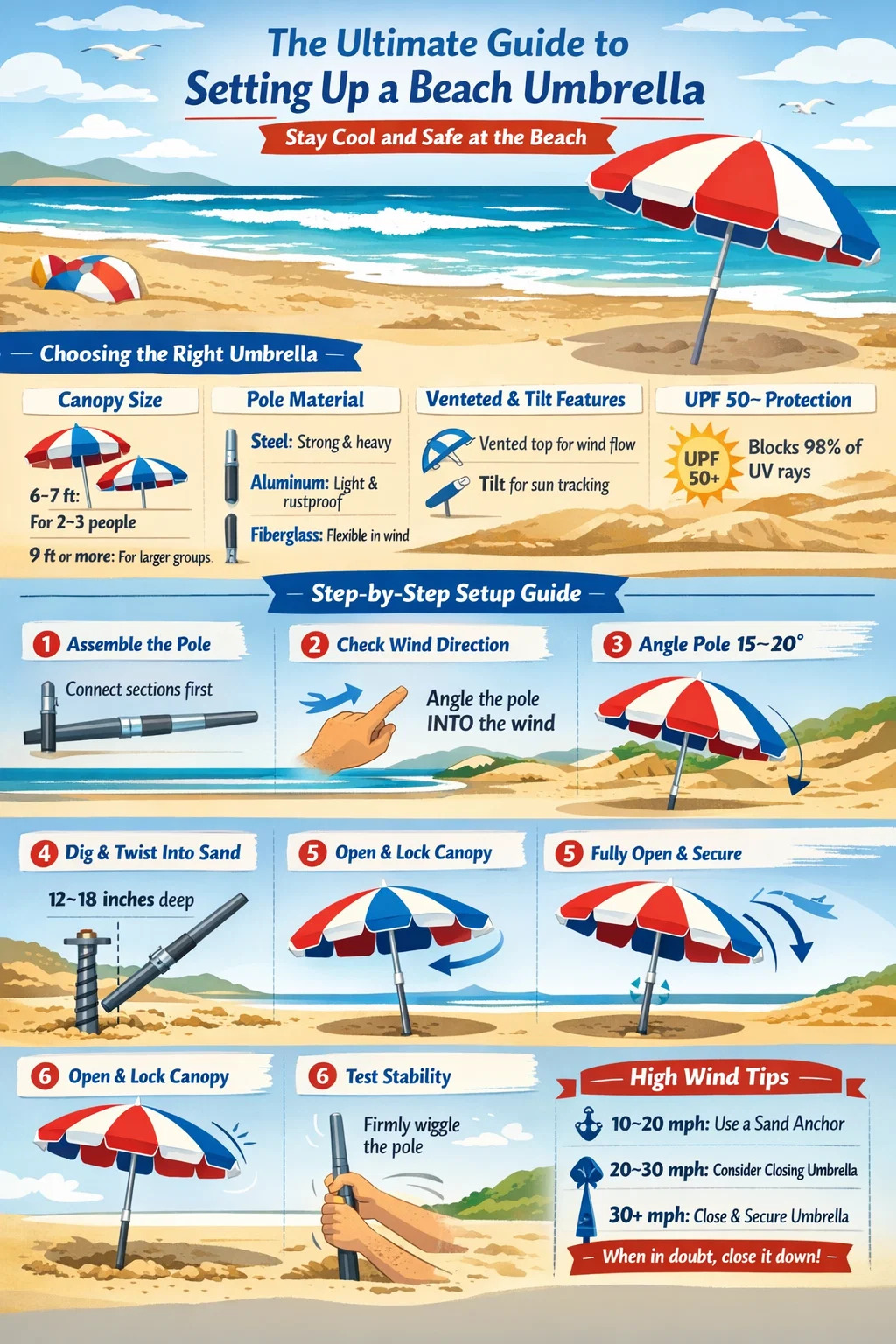
Setup success starts before you leave home. Not every beach umbrella handles wind or sun the same way, and the differences matter more than most people expect.
Canopy Size and Coverage
A 6-foot beach umbrella covers roughly 28 square feet of shade — enough for one or two adults lying flat. A 7-foot model bumps that to about 38 square feet, suitable for a small family. If you're going with four or more people, a 9-foot market-style umbrella or a shade tent makes more sense. Standard beach umbrellas sold at most retailers measure between 6 and 7.5 feet in canopy diameter.
Pole Material and Sturdiness
Steel poles are heavy but extremely stable — ideal if you're staying in one spot all day. Aluminum poles are lighter (typically 2–3 lbs versus 5+ lbs for steel) and resist rust, making them better for frequent beach trips. Fiberglass poles are the most wind-flexible and least likely to snap in a strong gust, which is why they're used in hurricane-rated beach umbrellas tested to winds of 50+ mph.
Tilt and Vent Features
A tilt mechanism lets you follow the sun's arc without repositioning the pole — critical for all-day beach sessions. Vented canopies have a small opening at the top (usually 6–10 inches across) that lets wind pass through rather than pushing the canopy sideways. In sustained 15 mph winds, a vented canopy reduces lateral force by approximately 30–40% compared to a solid canopy. If you beach in a consistently breezy area, a vented canopy is worth prioritizing over any other feature.
UPF Rating
Look for a UPF 50+ rating, which blocks 98% of UV radiation. Lower-rated fabrics — or fabrics that have faded from years of sun exposure — can let through significantly more UV light than most people realize. A beach umbrella with no UPF rating isn't necessarily useless for sun protection, but you're taking a gamble on actual UV blockage.
Picking the Best Spot on the Beach
Location selection affects both comfort and safety. A poorly chosen spot makes even a well-set umbrella harder to keep upright.
- Set up at least 50–60 feet from the water's edge. Wet sand near the surf is loose and unstable — it looks firm but won't hold a pole securely. Dry-packed sand further up the beach grips the pole far better.
- Note the wind direction before you plant anything. You want the natural windbreak of dunes, vegetation, or even a line of parked beach carts to your back if possible.
- Avoid low-lying areas where water pools after waves or rain — wet sand beneath your setup saps structural integrity throughout the day.
- Face the canopy opening toward the water (not into the wind) so the wind works with the angle of your pole, not against it.
- Maintain at least 6–8 feet of clearance from other beachgoers' setups — both for courtesy and because a tilted umbrella can reach farther than people expect.
Step-by-Step: How to Set Up a Beach Umbrella Properly
Follow this sequence exactly. Skipping or rearranging steps is how umbrellas end up loose or tilted the wrong direction an hour in.
Step 1: Assemble the Pole
Most beach umbrellas have two-piece poles that push or screw together. Connect them before inserting into the sand — trying to add a second pole section once the base is buried is frustrating and often loosens the first section. Make sure any locking button or collar clicks fully into place.
Step 2: Find the Wind Direction
Wet a finger and hold it up, or watch nearby umbrellas and flags. You need to lean your beach umbrella into the wind — not away from it. This is the single most common mistake people make. Angling away from the wind means the breeze catches the canopy like a sail and yanks the pole out.
Step 3: Position the Pole at the Correct Angle
Tilt the pole 15–20 degrees toward the wind before you push it in. That angle counteracts the force the wind exerts on the canopy. A fully vertical pole gives wind the maximum mechanical advantage to topple it. Think of it like leaning into a strong wind when you're walking — same principle.
Step 4: Sink the Pole Into the Sand
Place the pointed tip of the pole on the sand surface and push downward while rotating clockwise. The twisting motion displaces sand rather than compacting it, which gives a tighter grip. Aim for a minimum burial depth of 12 inches — 18 inches is better, especially in loose or dry sand. A good rule of thumb: you should not be able to wobble the pole with a single hand after insertion. If you can, go deeper.
If the sand is very loose, use your heel to pack sand around the pole base before and after insertion. Some beachgoers pour a small amount of seawater around the pole base immediately after setting it — the water helps the sand particles settle tightly around the pole as it dries, creating a firmer grip within 10–15 minutes.
Step 5: Open and Lock the Canopy
Slide the runner up the pole to open the ribs, then engage any locking mechanism (push-button, collar lock, or set screw depending on the model). Never leave the canopy partially open — a half-opened umbrella catches wind unevenly and creates unpredictable force on the pole. If your umbrella has a tilt function, set the tilt after the canopy is fully opened and locked.
Step 6: Check Stability One More Time
Grab the pole with both hands near the base and push sideways. You should feel firm resistance from the sand. If the pole moves more than an inch or two under moderate pressure, remove it, add a sand anchor (see below), and reinsert. Do not skip this check.
Using a Sand Anchor for Extra Stability
A sand anchor is a screw-shaped device (usually plastic or aluminum, 10–15 inches long) that you twist into the sand first, then slip your umbrella pole through the center. This massively increases holding power — particularly in fine, dry, or powdery sand where a pole alone tends to wobble. A quality sand anchor like the Sport-Brella or Shibumi Shade anchor can hold a beach umbrella stable in winds up to 35 mph when used correctly.
To use a sand anchor:
- Twist the anchor straight down into the sand until the top is flush with or just below the surface.
- Thread your umbrella pole through the anchor's center opening.
- Adjust the angle of the pole (15–20 degrees into the wind) before pushing it into the ground through the anchor.
- Pack sand around both the anchor and the pole base.
- Test stability as described above.
Sand anchors cost $15–$35 and are reusable. If you beach regularly, it's one of the most cost-effective additions to your kit.
How to Maximize Shade Coverage Throughout the Day
The sun moves roughly 15 degrees per hour across the sky. A beach umbrella that provides perfect shade at 10 AM will be nearly useless in the same position by 2 PM. Here's how to stay covered:
Use the Tilt Function Actively
Most quality beach umbrellas allow you to tilt the canopy up to 45 degrees in any direction. Unlock the tilt, reposition the canopy, and re-lock every 1.5–2 hours. This alone extends effective shade coverage by several hours without moving your entire setup. If your umbrella doesn't have a tilt mechanism, consider whether a replacement is worth it — they're a significant comfort upgrade.
Orient the Setup for Morning vs. Afternoon Shade
If you arrive early and plan to stay all day, set up slightly further east than your ideal midday spot. The morning sun comes from the east and the afternoon sun from the west — an eastward offset means you'll be naturally in better shade as the afternoon heat peaks. It sounds like a minor tweak, but it reduces how often you need to reposition your entire setup.
Supplement with a Beach Tent or Shade Sail
For families with young children or anyone spending 6+ hours on the beach, a standalone beach umbrella rarely provides enough shade. Pop-up beach tents (sometimes called cabana tents) offer 360-degree shade and typically weigh 4–6 lbs. They work well alongside a beach umbrella rather than as a complete replacement — use the umbrella for mobile shade while relaxing in a chair, and the tent as a base for kids or gear.
Beach Umbrella Setup in High Wind: Safety and Practical Tips
Beach umbrella accidents send thousands of people to emergency rooms in the US each year. According to a study published in the journal Injury Epidemiology, beach umbrella injuries spiked in the 2010s, with the majority caused by improperly secured umbrellas becoming airborne in wind. A standard beach umbrella in a 30 mph wind can generate enough lift to become a serious projectile.
Wind Speed Guidelines
| Wind Speed | Condition | Recommended Action |
|---|---|---|
| 0–10 mph | Light breeze | Fully safe; standard setup |
| 10–20 mph | Moderate wind | Use sand anchor; check every 30 min |
| 20–30 mph | Strong wind | Sand anchor required; consider closing canopy |
| 30+ mph | High wind / gusts | Close and secure the umbrella; do not use |
What to Do When Wind Picks Up Unexpectedly
If you notice your beach umbrella starting to rotate or tilt on its own, that's your signal to act immediately. Close the canopy first — this removes wind resistance and buys you time to reassess. Do not try to hold the canopy open while the wind is actively pushing it. Once closed, either reangle the pole further into the wind or collapse the entire umbrella and switch to a beach tent. A closed beach umbrella next to your blanket causes zero harm; an airborne one absolutely can.
Adding Weight at the Base
Some beach umbrellas come with or are compatible with a base weight bag — a canvas or nylon bag you fill with sand and hang around the pole above ground level. While this doesn't replace proper burial depth, it adds meaningful resistance to lateral tipping. Alternatively, placing a heavy cooler or packed beach bag at the base of the pole accomplishes a similar effect in a pinch.
Common Beach Umbrella Setup Mistakes and How to Fix Them
Mistake: Pointing the Umbrella Away from the Wind
This is by far the most common error. The instinct is to angle the umbrella so it shields you from the wind, but that means the canopy acts like a sail. The corrective fix: always angle toward the wind, not away. The canopy should open away from the wind, with the arc of the canopy facing downwind.
Mistake: Not Going Deep Enough
Pushing the pole 6–8 inches feels like enough, especially in firmer-looking sand. It isn't. Wind exerts a lever-arm force on the canopy, and a shallow insertion gives that lever far too much advantage. Always target 12–18 inches minimum, and test with a two-handed shake before opening the canopy.
Mistake: Setting Up in Wet Sand Near the Waterline
Wet sand near the surf looks compact and firm. But each wave wets and re-loosens the sand around your pole, progressively reducing grip over the course of an hour. Move back to the dry zone above the high-tide line, where sand grips consistently throughout the day.
Mistake: Leaving the Umbrella Unattended During Wind Changes
Sea breezes often shift 20–30 degrees over the course of a day as thermal patterns change. An umbrella angled correctly at 10 AM may be angled dangerously wrong by noon. If you're going for a swim, close the canopy. It takes 30 seconds. A tilted or flying umbrella doesn't care that you were only gone for 10 minutes.
Mistake: Using a Damaged Umbrella
Bent ribs, a cracked pole, a fraying canopy — these compromise the structural integrity of the whole umbrella in ways that aren't always obvious until wind puts it under stress. A bent rib alters how wind force distributes across the canopy. A hairline crack in the pole can shear under load. If your beach umbrella has sustained damage, replace the affected parts or retire the umbrella entirely.
Setting Up a Beach Umbrella Without Pointed Tips
Some beach umbrellas — particularly heavy-duty market umbrellas or those with rounded base ends — aren't designed to be pushed directly into sand. For these, a freestanding weighted base or a screw-in sand plate adapter is necessary. Fill the base with sand (16–20 lbs worth) and compact it thoroughly. While these setups are less stable than buried-pole configurations, they work acceptably in calm to moderate conditions and are useful for hard-packed beaches where pole insertion isn't feasible.
Alternatively, look for a bolt-on sand screw adapter — a threaded metal sleeve that attaches to a rounded pole base, giving it the ability to be twisted into the sand like a standard beach umbrella. These cost $10–$20 and expand the usability of non-beach-specific umbrellas significantly.
Packing Up and Storing Your Beach Umbrella
Taking down a beach umbrella is faster than setting it up, but a few habits will extend the life of your equipment significantly.
- Close the canopy before removing the pole from the sand. Pulling a fully open beach umbrella straight up can stress the ribs and runner mechanism.
- Reverse-twist the pole counterclockwise as you pull upward. The same mechanics that helped you sink the pole can assist in removing it cleanly.
- Rinse sand and salt off the canopy with fresh water after every beach visit. Salt accelerates fabric degradation and corrosion on metal poles and hardware.
- Allow the canopy to dry completely before storing. A beach umbrella packed away wet grows mold and mildew rapidly, particularly inside a storage bag with limited airflow.
- Store with the canopy loosely folded rather than tightly rolled. Tight rolling stresses the canopy fabric at fold points, leading to premature cracking or fraying at creases.
- Inspect ribs and pole sections at the start of each beach season — catching a developing crack or corrosion spot early is far cheaper than replacing a full umbrella mid-summer.
Beach Umbrella Accessories Worth Considering
A few well-chosen additions make the whole beach setup experience smoother:
- Sand anchor: As covered above — a strong investment for anyone who beaches in breezy conditions. Brands like AnchorUbrella and Shibumi are well-reviewed.
- Universal tilt clamp: If your umbrella lacks a built-in tilt, a clamp-on tilt adapter (fits most 1-inch to 1.5-inch poles) costs around $12–$18 and adds directional shade control.
- Pole insertion tool: A simple T-handle insertion device that threads over the pole and gives you more torque when twisting into hard-packed sand. Useful if you beach on compacted shores where standard hand-twisting isn't enough.
- Carrying bag with shoulder strap: Most beach umbrellas come with a flimsy sleeve. Aftermarket bags with padded shoulder straps make the walk from the car to the beach substantially easier, especially with a full gear load.
- Umbrella side panel or curtain: Some beach umbrella systems offer clip-on side panels that block low-angle morning or late-afternoon sun — useful if you stay for sunrise or sunset sessions.
Beach Umbrella Setup for Kids and Families: Extra Considerations
Children's skin burns in a fraction of the time that adult skin does — fair-skinned kids can begin to burn in as little as 10–15 minutes of direct sun exposure during peak hours (10 AM to 4 PM). A beach umbrella is part of a protection strategy, not the entire strategy. Here's what else matters in family setups:
- Position a beach tent or enclosed shade structure behind or adjacent to the umbrella for infants and toddlers — they can't easily move out of sun on their own, and a single umbrella won't maintain full overhead coverage for a crawling child.
- Never stake a beach umbrella directly adjacent to a play area or sandcastle zone where children are kneeling or sitting at pole height. A child running into an improperly capped pole tip at eye level is a real hazard. Check for rubber tip caps on the pole and replace missing ones.
- Set the umbrella lower (if height-adjustable) when toddlers are present — lower canopy height reduces wind leverage and keeps the structure more stable in light breezes.
- Pair umbrella shade with SPF 50+ sunscreen applied 20–30 minutes before sun exposure. Shade reduces UV exposure significantly but not completely — reflected UV from sand and water can still reach skin under a canopy.
Recommended products
Contact Us Now
Copyright 2024 @ Shaoxing Jinqiao Umbrella Co., Ltd. All Rights Reserved. OEM/ODM umbrellas manufacturers Custom Umbrellas Factory
